Showing posts with label Literature. Show all posts

Sunday, March 1, 2020

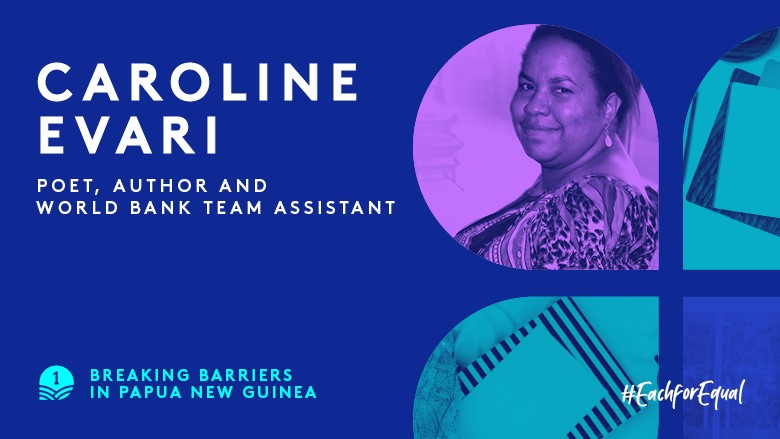
Breaking Barriers in PNG: Caroline Evari

Image

By World Bank

For International Women’s Day 2020, we’re getting to know the pioneering women across the Pacific and Papua New Guinea who are breaking barriers and creating change for the decade ahead. Caroline Evari began writing at the age of six. She is now the author of 28 children’s books and has published her own book of poems, Nanu Sina: My Words, all while supporting the World Bank and it’s nine projects in Papua New Guinea and raising two sons.
What inspired you to start writing at such a young age?

After I had completed first grade in school my family moved from Port Moresby back to my father’s village in Oro Province. I was supposed to continue on to grade two, but there weren’t any schools nearby so I spent my childhood days writing. I would just walk around the village with a notebook and describe whatever I could see. It was my way of keeping myself in school.

Did you eventually go back to school?

Yes, I moved back to Port Moresby in 2001 and started school again. I realized I was doing so well in English compared to other subjects because I spent my time away from school writing. So, I was able to catch up quickly.

Later on, when I attended Marianville Secondary School, we were required to keep school journals every year, and that’s how I discovered my talent for writing poems. At the end of grade 12 I had written a total of 60 poems and they now make up the majority of my book, Nanu Sina: My Words.

What do you love about writing poetry?

For me, poetry is the best way to express myself. Most of my published poems were written when I was growing up, at a stage when I was living away from my parents. I missed them, but I wanted to achieve something with my life so I had to somehow let go of those emotions and thoughts. I find poetry a really good way for people to let go of any stress, anxiety, depression or anything that may be pulling them down.

How did you get into writing children’s books?

In 2017, I wrote two children’s stories titled Zuki the Crocodile and Old Mulga and the Pawpaw Tree for the organization Library for All. The stories were then developed into picture books in 2019 and distributed to schools around PNG.

Given that I work with the World Bank, I could see that we shouldn’t just advocate for Papua New Guineans to learn to read, we need to also write our own stories and have them published into books. The majority of the books in schools are not written by us, they are written by people from other parts of the world.

I had this idea: what if we started teaching our people to write their own stories? Or what if we started teaching each other to express ourselves through poetry? That would have a big impact. I started reaching out to schools and teachers and motivating them to encourage their students to write their own stories. I give free talks in schools on why writing is so important and I hold children’s story writing workshops.

You’ve been lucky enough to be mentored by popular PNG writer, Rashmii Amoah Bell – what was that like?

Yes, in 2016, along with 45 other PNG women, I contributed to the My Walk to Equality anthology that Rashmii edited – it was the first ever collection of writing from Papua New Guinean women.

Rashmii then mentored me for the first six months after I published my book of poetry. It was really important for me because Rashmii is someone that I look up to as a role model. We don't often have Papua New Guinean women as  professional mentors. We are always looking outside PNG for inspiration and motivation. But, in this case, I was very privileged to receive that mentorship from her, and it was really inspiring for me.

Do you think there will be more female PNG writers in the future?

Yes, and I do believe we already have a good number of Papua New Guinean female writers. There’s a lot of change and positive responses from communities with women being more vocal, and it's really a good thing to see. So I hope that this momentum of women writers gaining support will continue to increase.

What are your hopes and plans for the future?

I'm already working on another book of poems, but my hope for the future is to write more; not just poems, but more children's story books. I want to help capture our culture and languages that are dying away.

I also hope that my two sons will grow into responsible men that are able to respect and understand women. I want them to accept women as they are; seeing women as equals in society. I think that’s my biggest aim for my sons’ future.

Follow us on Facebook to make sure you don’t miss any of our Pacific Women Breaking Barriers series.

Go to this link for more: https://www.worldbank.org/en/news/feature/2020/02/28/caroline-evari?fbclid=IwAR3WKp2UBlbHyccDCzIGvbV1cPEfhj5ef7mwkjtIvl4tNR__2sK35DLKpjk

Wednesday, January 15, 2020

Making a start on a PNG book catalogue

_Croc Prize logo

By BAKA BINA - PNG Attitude 

PORT MORESBY - Writings about Papua New Guinea and books by Papua New Guinean authors are multiplying but scattered all across the country.
There has never been a central reservoir of information about them. And there should be.
Most of these books are self-published by the authors, sometimes assisted by experienced people like Francis Nii and Jordan Dean, and produced using the Amazon hard copy and Kindle Direct Publishing ebook platforms.
Libraries For All has helped several authors including Caroline Evari while others like Ms Solien does her own publishing.  I am also doing my own.  A few others are engaged with commercial publishing companies.
But we do need a central information data place to list all these books. I’ve made a rough start at a catalogue which you can download here.
Not mentioned? So how about you get your title and name on the list? Just email me here with a short description and cover shot of the book.
And include this information:
Book title
Author
Category of book (see my note at the end of the catalogue)
Year published
Number of pages
Publisher

Go to this link for more: https://www.pngattitude.com/2020/01/making-a-start-on-a-png-book-catalogue.html

Friday, November 15, 2019

Prisoners eager to write


Posted on The National

INMATES at Bomana Prison in National Capital District are keenly looking forward to share their experiences in book form through what is known as the Prison Writers Workshop.
A duo testified during the National Book Fair held at the National Library in Waigani last week that they would love to tell write about prison life like their colleagues at Buimo in Morobe and Kerevat in East New Britain had done already.
Dandan Tom from Waima Village in Milne Bay spoke about how reading and writing had liberated him while he was confined within four walls of a prison cell.
“I’m in prison but my reading has taken me out of prison to places all over the world,” Tom told attendees of the book fair.
For the past 20 years of a life sentence served in Giligili Prison in Milne Bay and Bomana, reading had taken him to fast-paced American cities, the expansive plains of the Africa continent and many other places in between.
Tom is a self-professed bookworm.
“I’ve read all of John Grisham and Wilbur Smith’s novels as well as other reading material in the prison library that caught my interest. Reading has freed my mind from stress and has given me much knowledge of the outside world.”
He not only reads but writes as well.
“I’m halfway through writing my own story using a computer in the prison library. Writing also releases stress and gives me ideas and broadens my mind. I’m also a song writer.
“Why can’t Bomana do the same as Buimo and Kerevat? We need people to mentor prisoners to write their stories and publish them.”
Fellow prisoner Paul Joe, who is also serving a life sentence, testified that he was illiterated when he entered jail but through a literacy programme, he was able to read.
“I now read the Bible which gives me hope in the prison,” he said.
The two were among a group of inmates let out to join students and a number of writers/publishers at the National Book Fair.
They spoke of their eagerness and desire to read books which has helped them escape the drudgery of prison life.
Organisers of the book fair had invited the prison management to take the prisoners on leave of absence to be part of the event.
Professor Steven Winduo of the University of PNG who has been a part of the Prison Writers Workshop and assisted in publishing the work of the Buimo and Kerevat inmates, took note of the Bomana inmates’ testimonies.
Inspector Eko Mangere, officer in charge of rehabilitation, parole and juvenile justice at the Correctional Service headquarters, said the department would like to see more inmates involved in literacy programmes as part of the rehabilitation process.
Poet and children’s book author Caroline Evari, who made a presentation at the National Book Fair, called for more Papua New Guineans to write to promote the country and also to help preserve cultures and languages that could be lost for good otherwise.
Evari said writing about different aspects of the country would helpd to cure the “disease of a single story.”
She explained that there were stereotypes because not much literature was out there for the rest of the world to read and understand PNG better.
Prison writers like Tom have been invited to be part of the book fair again next year.

Go to this link for more: https://www.thenational.com.pg/prisoners-eager-to-write/

How literature can deliver for the country


By Daniel KUMBON - The National

IT WAS like slowly, scaling the steep ice-covered walls of Mt Everest as we three writers waited for more than a month to present a petition for the Government to recognise PNG literature to Prime Minister James Marape.
And when front desk staffers asked us to wait another three weeks it seemed we had reached the death zone of that great mountain.
I was just about ready to pack my bags and go back to Wabag in the misty highlands.
But then on Thursday, Oct 31 I received a message from the prime minister’s office asking us to immediately furnish him with information about why we wanted to see Marape.
So we did exactly as we were requested, and – while we’re still waiting for the next move – I thought I’d share with you a summary of the contents of our letter, which was written on behalf of more than 300 petitioners – including scores of Papua New Guinean writers, authors, poets, commentators, publishers and editors – who want to see the Government support sustainable home-grown literature in PNG.
So, at this moment, Caroline Evari, Betty Wakia and I await a further message from Marape which will see us ushered into his presence for a few words about the massive benefits developing our own literary tradition can bring to PNG.
We started by informing Marape that PNG’s writers and their supporters had decided to petition the Government immediately after he was elected as PNG’s eighth prime minister. The story we told him went something like this….
We writers really liked James Marape’s war cry to ‘Take back PNG and make it the richest black Christian nation on earth’. We figured that here was a prime minister we could trust. We believe that every citizen must support his clear vision for the nation by engaging fully in activities they are good at.
We hold the strong view that literature can play a significant role in nation-building. It can have a powerful influence on education, on culture and on focusing people on how to create a strong and progressive society.
Unfortunately the power of these contributions has been ignored by successive governments.
Billions of kina has been spent on education over the years but there is little to show for it. Most schools are run down. There are few public and school libraries. Most students speak poor English. And our illiteracy rate remains one of the highest in the world.
A home-grown literature can impact positively on educational standards, it can preserve our traditions and cultures, it can encourage a sense of pride in our people and it can tell the story of our great nation to the world.
A nation without a story is like a nation without a soul.
And Papua New Guinea has writers. It has authors, editors and publishers. But these people are largely unrecognised in our society and their books are largely unread.
PNG’s writers are struggling to tell our nation’s story. There are no major publishers in the country interested in publishing our work. If they want to publish books, they pay for them. Because of this, most PNG-authored books would reach fewer than 100 people.
PNG-authored books are not available in schools and libraries. Our students cannot read books written by their own countrymen and women. Instead, they read books by writers from other countries.
In most cases Papua New Guinean authors pay to have their books printed and donate them so people can read them.
Our national literary award, the Crocodile Prize, established in 2011, is struggling to survive. It is supported by limited private funding and the government has never shown real interest in it.
We writers feel it is time this situation changed.
Our main wish is to see our books, including those already published, purchased by the Government and distributed to libraries, schools, universities and other educational institutions in our country.
Our writers think of how good it would be that, in every government office there was a small book case full of PNG-authored books – novels, biographies, poetry, children’s picture books, history, commentaries and the rest.
A bookshelf offering a clear, material statement of our culture, our sophistication and our civilisation.
The books exist but the means of getting them on the shelves do not.
To become a literary society and to develop a reading culture, Papua New Guinea needs to redirect some of its own book-buying budget to local authors – and to encourage NGOs and corporate business to help out in the same way.
A typical PNG-authored book will cost less than K20.
The Government and its agencies can assist by sponsoring the Crocodile Prize national literature competition and encouraging the formation of provincial writers associations.
We writers are keen to introduce a Prime Minister’s Award for the Best Book each year- one each for a male and female author.
The key government agencies that should be actively involved are the Department of Higher Education, Research, Science and Technology and the Department of Education. Their roles will be to assist develop operational libraries and to purchase and distribute books.
We also feel the National Library, the National Cultural Commission and the Ministry of Tourism Arts and Culture can also play a part in this project.
The outcome of the project will be a win-win for writers, readers, educators, students and the people of PNG.
And it will particularly encourage new writers and new readers.
Right now, Papua New Guineans – when they read – are mainly reading books written by outsiders.
Reading about their own country, their own people, their own stories and issues, will be a huge incentive and a massive source of national pride.
It is argued, even by experts, that Papua New Guinea has no reading culture. One reason for this is that there are so few PNG-authored books available to be read.
We are confident this will change if writers can be connected to readers through the books they produce. But this will happen only if the Government intervenes to ensure that the necessary steps are taken.
If the Marape-Davis Government responds to our request, this virtuous circle can be created – and the nation will benefit.
With a better informed, empowered and more literate population, James Marape’s vision to make PNG a prosperous nation will well be on track.

Go to this link for more: https://www.thenational.com.pg/how-literature-can-deliver-for-the-country/

Sunday, September 1, 2019

National Book Week should stimulate tangible benefits


File:Children at Buk bilong Pikinini (books for children). Port Moresby, Papua New Guinea. (10682080206).jpg

By FRANCIS NII - PNG Attitude

KUNDIAWA - It is high time the meaningless and vain annual National Book Week was changed to make it become the vehicle for stimulating tangible benefits to writers and readers.
Every August features National Book Week. In Papua New Guinea gaudy banners of all sizes rustle in the dusty wind. Written on them is an ostensibly witty theme that nobody cares about.
Empty-minded school children in colourful uniforms fill the city arena for the annual event.
For them, it is one of those playtimes. Their predecessors have celebrated it and so will those who come after them.
Whether there is gain for them or not, it doesn’t matter. At the end of the day, they will go home without a locally-authored book. That they knew. They had experienced it before.
High ranking government officials and distinguished dignitaries mingle at the overly draped grand podium. It’s their day to showcase their oratory eloquence.
Pompous speeches of vanity ring out in crescendo. Blind ovation reverberates into emptiness in the scorching atmosphere.
No national author is present for the event. No locally-authored book is on exhibition. It is supposed to be a National Book Week celebration of locally-authored books, isn’t it? Who knows why? Who knows what kind of books they celebrate?
A meaningless and derisory celebration that should not be called National Book Week. A slap in the face to the multitude of national authors in this country.
No one even knows or cares to how many national authors there are in the country. Nor what kind of books they produce. Nor what their books look like. Nor how good their stories are. They don’t know and they don’t care to know the importance and value of the books that have been written.
So what is the meaning of the annual National Book Week? What is its purpose? What kind of benefits are there and for whom?
The children go home without seeing a locally-authored book. They don’t embrace a copy on their way home, let alone read one. Is it because Papua New Guineans don’t write books?
No. There are many national authors publishing all kinds of books from non-fiction to fiction, as well as collections.
There is no meaning when national authors are ignored. There is no purpose when nationally authored books are neglected and cannot be read. It is absurdly unfair when the younger generation cannot read books about their own history and culture.
Yet it is called National Book Week and is celebrated year after year with all the pompous grandeur without locally-authored books. Sad vanity, isn’t it?
It’s time to reconsider. Make the occasion more meaningful. Recognise local authors. Make available their books. Stimulate opportunities for tangible benefits everyone – authors and readers alike.
The PNG government and the National Library and Archives need to make a drastic policy shift.
Local authors and their books must be given recognition. Their books must be made available at such important occasions, including National Literacy Week, for school children and the general public to take these books home and to read them.
Revive the provincial public library network throughout the country and stock them with locally-authored books.
Make National Book Week an occasion of celebrating and promoting our own books. It should be the vehicle for nurturing readership for locally-authored books.

Go to this link for more: https://asopa.typepad.com/asopa_people/2019/09/national-book-week-should-stimulate-tangible-benefits.html

Tuesday, July 9, 2019

Crocodile Prize launches 2019 short story and poetry contests


2017 awards
The last Crocodile Prize awards in 2017 were hosted by writer Martyn Namorong, himself one of the first award winners in 2011
By KEITH JACKSON - PNG Attitude
PORT MORESBY – Poets and short story writers can fire up their computers and blow the dust off their notebooks now that Crocodile Prizeorganisers have announced the launch of the 2019 awards in both these important genres of writing in Papua New Guinea.
Both awards have a tight deadline for entries of Saturday 31 August and offer large cash prizes as well as publication in the prestigious 2019 Crocodile Prize Anthology.
The winning short story will be awarded to the best original, narrative-based prose by a Papua New Guinean author.
There no strict word limit but judging will be based on quality ahead of quantity.
Contest organisers say creativity and originality are important and highly considered will be the relevance of the perspectives presented as well as style, coherence of ideas, form and structure.
Previous short story winners were Jeffrey Mani Febi (2011), Charlotte Vada (2012), Leonard Fong Roka (2013), Agnes Maineke (2014), Hazel Kutkue (2015) and Alison Kult (2016).
There was no short story award in 2017 and no Crocodile Prize contest in 2018.
The award for poetry is keenly contested and in previous years this category has always had by far the most entries.
Many exceptional poems have been written and judges have never found it easy to select the most outstanding.
Winners in previous years were Jimmy Drekore (2011), Michael Dom (2012), Lapieh Landu (2013), Diddie Kinamun Jackson (2014), Philip Kaua Gena (2015) and Wardley D Barry-Igivisa (2016) and Annie Dori (2017).

Go to this link for more: https://asopa.typepad.com/asopa_people/2019/07/crocodile-prize-launches-2019-short-story-and-poetry-contests.html

Monday, July 8, 2019

Author wants more PNG books written and read


By ALPHONSE BARIASI - The National

AN author and mother of two from Northern has just published a collection of poems following her success in writing more than 20 children’s story books.
Caroline Evari says the poetry in Nanu Sina: My Words is divided into four themes: Conflict (fear, doubt, anger, worry, disobedience); relationships (love, heartache, violence, regret and loneliness); hope (the future, persistence, determination, struggle and survival); and family (advice, mothers, siblings, children and a celebration of life).
“My main message portrayed in the book is freedom of expression through writing,” the mother of two boys says.
“I find that when it comes to expressing themselves, most people find it difficult. One way of expressing yourself is through writing and I find poetry to be an ideal platform for me.”
Evari plans to publish several other books soon.
She draws her inspiration from her experiences and surroundings.
She says a lot of students today are spending more time on their phones than in reading books.
“As a result, there is less interest in reading or writing and I see that the literature level is decreasing. If you go on social media such as Facebook, you will find a lot of grammatical errors, this itself is a reflection on the country’s literature.
“Papua New Guinea is land of oral story tellers, we should be producing great writers too.”
Evari is the last of six children born to Alphonse and Margaret Evari from Northern. Her dad is a retired mechanic who was once the workshop manager for the NCD Parts and Services.
He retired in 1997 to contest the national election and the family moved to Musa, in Northern.
“There weren’t many schools in the village so even though I was supposed to be in Elementary 2, I ended doing Grade 5 in one year and spent the rest of the year in the village being an ordinary village kid,” Evari says.
“In 2001, my dad brought me over to Moresby and I was enrolled at the St Peter Channel Primary School in Erima in 2002 where I did Grade 5 and completed Grade 8 in 2005.
“I then passed to Mariaville Secondary School to do Grade 9 in 2006 and completed Grade 12 in 2009.
“I was accepted to do Science Foundation at the university in 2010 and after completing the third year in Computer Science in 2012, I decided to look for employment because my family could not send me back to complete my final year.
Evari developed a liking for poetry when she was 15 years old.
Nanu Sina: My Words is not her first published work. She had writer four children’s illustrated story books already.
The winner of awards under the Crocodile Prize competition, she recommends aspiring PNG writers to try entering it.
“This is a good platform for increasing interests in literature. The competition currently has prize awards for four categories: Women in writing; children’s writing; essay and journalism; and heritage writing.
“The prize for each category is K5,000 and I would like to call upon a potential sponsor for a “Schools Writing” category to get schools to compete. This is another way of generating interest.”
Evari has also embarked on a voluntary journey called “The NCD school talk series” as part of her book promotion drive.
“I will be speaking to students about:
My journey and experience as a Papua New Guinean writer;
The importance of writing and publishing as a Papua New Guinean; and
The platforms available for aspiring writers.
Evari encourages PNG writing because she says there are too many foreign materials in this country, including reading, writing and learning materials.
“Western culture is taking over and soon our culture will disappear completely.
I have been advocating for the need to preserve our heritage through writing and publishing. We need to instill in our next generation the importance of preserving our languages, traditional values and ways before it is too late.
“There is also a need for PNG authored books to be placed on every library in this country. We need our children to be reading our own stories.
Stories that are of relevance to our ways and those that they can resonate with and pick out practical lessons from.
“A country without literature is a country without identity. Hence, we need to take ownership of literature in this country.”
Evari has spent six years working as a team assistant with the World Bank Group PNG Country Office.
She has been writing since she was seven years old and has authored more than 20 children’s story books with the Library for All.
Her first four books developed into picture books are Zuki The crocodile, Old Mulga And The Pawpaw Tree, Zach And His Toy Truck and Let’s Go Up To The Mountain.
Evari is a contributing author to the My Walk to Equality anthology the first ever of writing from Papua New Guinean women. She has also written for the Crocodile Prize competition and spillwords.com and maintains a blog titled Every Battle on wordpress.com, Facebook and Instagram.
Her mission is to inspire a generation of aspiring writers to preserve our heritage through writing and publishing, produce reading, writing and learning materials relevant to PNG culture, traditions and surrounding, and one day have PNG authored books in libraries throughout the country.

Go to this link for more: https://www.thenational.com.pg/author-wants-more-png-books-written-and-read/


Outpouring of support in plea for survival of PNG literature


Related image
By KEITH JACKSON - PNG Attitude
NOOSA – A huge number of friends of Papua New Guinean literature - authors and readers from around the world - have signed a manifesto drafted by Phil Fitzpatrick asking prime minister James Marape to commit his government to provide support and recognition for PNG writers and literature.
This morning 150 people had shown their support, with many not only signing but offering reinforcing comments for the Marape government to consider.
The manifesto is the centerpiece of a petition organised by Caroline Evari that will be handed to Mr Marape and other senior politicians in the PNG parliament in an effort to provide home-grown literature with a solid foundation.
The manifesto seeks to stimulate meaningful, tangible and scaled up governmental and institutional support for PNG creative writing by influential people who will understand, endorse and support investment in literature as a transformative force in PNG society, education, culture and nation-building.
The truth is that the renaissance of PNG literature that began in 2011 is running out of steam and is in danger of stalling.

“Without an indigenous literature, how can Papua New Guineans know their own history and tell their own stories?” asked former kiap, senior Australian health bureaucrat and PNG Attitude commentator, Chris Overland.
“The creation of a body of indigenous literature is a prerequisite for the nation to be able to discover and define itself as something greater than its constituent parts,” Mr Overland said.
And writing from Barengigl High School alongside the treacherous highlands road that runs to Mt Wilhelm from Kundiawa, principal Roslyn Tony said, “we need our own home grown literature to keep the past and present alive in pen and paper”.
I visited Barengigl in March 2017 and told an audience of the entire school that their new principal, Ms Tony, just had an essay and a poem published in a book, a Papua New Guinean book.
I then extracted from my bilum a brand new copy of My Walk to Equality, which was to be launched in Port Moresby a few days later, and presented it to a delighted Ms Tony.
The school gave a Chimbu yodel that reverberated back and forth among the surrounding lofty mountains. The  new principal had been published in a book, the book was here in Barengigl and this was cause for excitement and joy. 
We also heard from Chimbu social welfare advocate, Philip Kai Morre, who said:
“Having books in schools is important to increase intellectual ability. Books transmit knowledge and wisdom. The education department needs to buy books produced by local writers.”
I couldn’t agree more. Those books exist (Pukpuk Publications has alone published over 50) but getting them into schools, libraries and people’s hands is an extraordinarily difficult and costly task.
“I support this manifesto,” wrote Richard Dinnen from Cairns, Mr Dinnen was the ABC’s PNG correspondent from 1999-2001.
“More than any nation, Papua New Guinea needs to develop written story-telling," he said.
“It frustrates me how little there is about PNG in books and literature. You have great stories, and PNG people are great story tellers. Do it now. For your country, your children, your future. Tell your stories - develop a thriving literature.”
From Port Moresby, author Baka Bina wrote:
“Gavman mas sanap wantaim yumi long kisim olgeta rait bilong mipela.” [The government must support us by purchasing our works]
“Ol man igat stori i dai isi isi igo na ol yanpela bai nogat moa stori long rit na kisim save bilong mipela yet long Papua Niugini.” [The people with the stories are gradually dying and younger people don’t have the stories that will give knowledge to us Papua Guineans]
“Sapos dispela tingting long noken givim tingting na sapot long ol lain bai rait holim pain na stori bilong mipela, mipela bai lusim pes na luk olsem ol mahn nogat hausman.” [If there is no support for authors and our stories, a significant amount of our culture will be lost]
“History is stories. Writers write stories. A nation is invisible if its stories are (perhaps) being written and yet not available to be read. Writers and readers together imagine a nation," said friend of PNG literature, Wendy Glassby.
And Francis Nii – the prominent Papua New Guinean author, editor, publisher, commentator & literature advocate – wrote:
“Literary excellence is the key to unlocking the hidden treasures of life. We as writers and publishers are solving the writing and production issues. But schools do not have funds to buy books and do not get them unless they are made available free of cost.
“There is a disappointing lack of support both from the government and aid donors to supply PNG-authored books.
“Stories are part of our culture; books are repositories of our culture. What is it that the authorities don't understand? A nation without literature is a people with lost identity.
“Can the current government, under prime minister James Marape, embrace national literature and PNG-authored books in his government's mission of making 'PNG the richest black Christian nation' by giving PNG authors and their work special recognition and supplying their books to schools around the country?”
Social commentator, journalist, author and self-described traditionalist, Daniel Kumbon from Enga, said he feared “so much of PNG’s rich traditions will be lost if not recorded down in whatever form”.
And former vice-chancellor of the University of Technology, Dr. Albert Schram, now living in Verona, Italy,  said:
“Writing is thinking, and reading is feeding the mind.
“We all have an interest in supporting PNG literature, which will help forming confident citizens with a strong sense of identity.
"Those type of citizens will be able so successfully interact with the rest of the world, and not become its victims.”
“This country needs to invest in its own literature,” poet Caroline Evari told us. “Instead of diverting money into foreign material and making the rich become richer overnight, let’s invest in our own writers and authors.
“Let’s encourage the publication of our stories, cultures, traditions and languages as a way of preserving our heritage which will soon disappear. Most importantly, let’s fill our libraries with PNG authored books and have a bookshop that is dedicated to publishing and selling PNG books only.”
And finally, to end these extracts of the many comments received at PNG Attitude, my great friend Corney Korokan Alone, a public affairs commentator who describes himself as “a thinking and patriotic citizen of beloved Papua New Guinea advocating for a better educated citizenry”, said:
“I firmly believe that we will create a smart, healthy and wealthy Papua New Guinea, an economic powerhouse that is driven by confident, professional, patriotic, tenacious and altruistic entrepreneurs, educators and role models in every space who are community centered.
“In doing so, we will lift up others along the way with that ladder of opportunity.
“To do that, we must articulate our own destiny. Tell our own stories clearly. PNG-born artists and writers who are able to differentiate the fluff and falsehoods that gets pushed down and absorbed without questioning and second thoughts. We must see that clearly and chart our paths.”
Exactly.

Go to this link for more: https://asopa.typepad.com/asopa_people/2019/07/over-100-voices-speak-up-in-plea-for-more-support-for-png-literature.html

Thursday, July 4, 2019

Writers of PNG - Now is the time to look your govt in the eye

CrocPHIL FITZPATRICK
TUMBY BAY - Perhaps the time has come for the writers of Papua New Guinea – authors, journalists, poets, commentators and others including publishers and illustrators - to look your government in the eye and make a statement.
Perhaps it is time to petition prime minister James Marape and other ministers and seek the government’s support for an authentic and home-grown Papua New Guinean literature - a literature that will help turbo-charge the serious nation-building task that lies ahead.
I propose here a draft form of words that can be sent to Mr Marape, together with the names of all the writers and readers who believe that PNG literature needs more than a thumbs up, it needs real practical support.

________
A Manifesto for Literature in Papua New Guinea
We, the writers of Papua New Guinea, believe that our nation’s literature is something that needs to be encouraged and supported by everyone, but especially by the government.
Without a home grown literature the story of our great nation cannot be told.
If our story is not told, future generations of Papua New Guineans will not be fully aware of where they come from, who they are and what made them.
A nation without a story is like a nation without a soul.
The writers of Papua New Guinea are currently struggling to tell our nation’s story.
There are no major publishers in Papua New Guinea interested in publishing our work. If we want to publish our books we have to pay for it ourselves.
Our books are not available in schools. The students of Papua New Guinea cannot read books written by their own countrymen and women.
Instead, they have to read books written by writers from other countries.
Papua New Guinea has a poorly resourced public library system. Few of our own books are available in these libraries. In most cases Papua New Guinean authors have to donate books free of charge to libraries so people can read them.
Our national literary award, the Crocodile Prize, is struggling to survive. It is supported by limited private funding. The Papua New Guinean government has never shown real interest in supporting it. Nor has the government shown an interest in supporting Papua New Guinean writers.
It is time this situation changed.
We, the undersigned writers of Papua New Guinea, are calling upon our new Prime Minister, James Marape, to commit his government and future governments to providing the support our writers, our literature and our nation deserve.
It is time to secure the story of Papua New Guinea for present and future generations.
To do less is unthinkable.

Go to this link for more: https://asopa.typepad.com/asopa_people/2019/07/writers-of-png-now-is-the-time-to-look-your-govt-in-the-eye.html?fbclid=IwAR1O3T1pbAgtvGDtvT2dJDdMHZ_k7WjHuJE-r4IyNmm9nNomL2usMfkzq5M

Featured Post

Cashless in China as I study for my PhD

                                WeChat and Alipay digital payment applications By BETTY GABRIEL WAKIA - posted on PNG Attitude Blog PORT MOR...