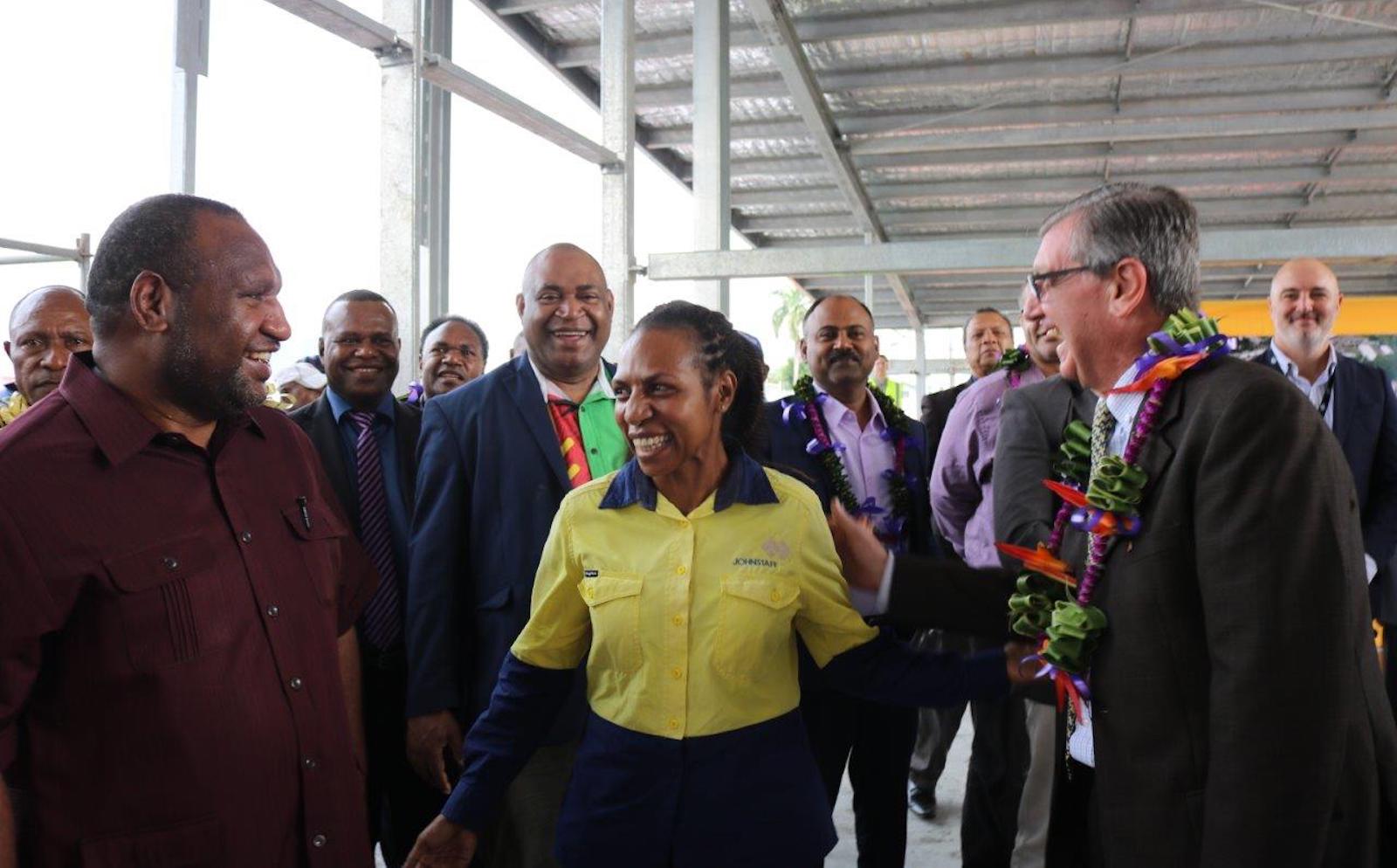
Papua New Guinea Prime Minister James Marape says the 22 reserved seats for women is not a fair and level playing field for women to enter politics in PNG, hence his government will not pursue it. Speaking at the first of its kind two-day PNG Political Parties and Women in Political Leadership Forum in Port Moresby today, the Prime Minister says he will not support the notion of the 22 reserved seats because he personally believes it is a downgrading avenue for women to enter Parliament.
Marape says he is a believer of women as equal to men and says the idea of the 22 reserved seats portrays that women are not equal.
Instead, the Prime Minister further believes women can win elections on their own merits if the environment of contest is a fair place.
Therefore, Mr Marape says his government will push for a cleanup in the entire electoral process to give both men and women a conducive environment to allow for a free and fair election environment so that women can feel free to contest.
He says for the next two years his government will clean the process of campaigning, voting and counting.
And a major part of achieving this, will be to work on electronic voting or the bio-metric system which promotes one person one vote.
ADELAIDE - I am a proud Papua New Guinean who will always stand very tall and speak boldly, loudly and clearly knowing that PNG is one of the best democracies. In this context I have some observations to make on the saga of the attempted arrest of former prime minister Peter Charles Paire O'Neill, another critical moment in the history of PNG’s political development.
Unfortunately, we once again see heightened evidence of corruption and power manipulation at the expense of PNG’s potential to develop and to fully use its natural, human and social resources to become a prosperous country.
According to available evidence, O’Neill had a calculated personal agenda when he entered the doors of PNG’s parliament in 2002 as the member for Ialibu Pangia in the Southern Highlands Province.
O’Neill was soon entrusted with the portfolio of labour and industrial relations by the government of Sir Michael Somare. But the new man had other ideas and was transferred to the post of public service minister in 2003.
His ambitions worried Somare ahd O’Neill was dropped from the ministry in 2005 whereupon he took his People's National Congress out of government, later that year emerging as opposition leader.
He tried a vote of no confidence in Somare and lost it - but O’Neill was never one for giving up and changed tactics. After the 2007 general elections, he rejoined the Somare government and regained his public service ministry.
O’Neill was on a mission of his own and no road block was going to stop him. There was a land of milk and honey out there and he was determined to land on it. It came a lot closer in 2010 when he was appointed finance minister.
Then, in 2011, Somare fell seriously ill and was hospitalised in Singapore for many months. The decent Tei Abal took over as acting prime minister but, wary of O’Neill, demoted him to the works ministry. But Abal was no match for the wily Southern Highlander.
O’Neill now was more determined than ever to secure the top job and joined a movement to unseat Somare, succeeding in tipping out of office the convalescing prime minister, 94 votes to 70. Somare challenged O'Neill in the supreme court, which ruled that Somare was the legitimate prime minister.
This precipitated a constitutional crisis when O’Neill refused to step down and for several months PNG had two prime ministers, two police commissioners and political chaos. The governor-general intervened and called an election in 2012, from which O’Neill emerged victorious as head of a coalition government.
There were still challengers in the ranks who sought to depose him, but by deft use of his ability to expand the ministry and reward local MPs with large grants, O’Neill remained in power. He was tough, ruthless and always did his groundwork. He was now seated on what he believed was his rightful throne.
But a turning point came in 2019. It could have been that O’Neill became too much the autocrat. It could have been that some powerful colleagues believed he had gone too far in enriching himself. It could have been that the country was hurtling into bankruptcy. But whatever the cause, a turning point was reached.
James Marape - previously a close confidante - baulked, and quit his position as finance minister.
O’Neill reacted by trying to recast his ministry with loyal supporters, sought to forge new alliances, using parliamentary procedure to try to thwart those seeking to oust him, resuming his usual practice of using the courts to force a pathway, exerted his dwindling authority on the media and even ‘promising’ to resign in favour of an ageing acolyte. All the while he ignored the constitution as he fought to retain his job.
It was all too late.
In his defeat on the floor of parliament, O’Neill fought to the last breath. He had reached the promised land and touched, tasted and accumulated the milk and honey. This last fight was for his ego.
Peter Charles Paire O'Neill’s tenure at the top was accompanied by dealings the PNG public are entitled to know about but O’Neill has thoroughly buried much of the detail. What evidence exists is for royal commission, police and courts to dig up.
He accomplished his mission. He played his game efficiently. He has his milk and honey. But now his ego is scratched and his friends are few and we Papua New Guineans, who have been the losers, want to see justice and fairness and prosperity return.
Is O’Neill above the law? None of us is above the law.
My war cry - as it should be for all young Papua New Guineans - is that this time, for once and for all, O’Neill needs to be prosecuted.
And we call on him to comply with legal proceedings.
ADELAIDE - In Papua New Guinea, members of parliament are not readily accessible to voters. Their offices are not located in the electorates. They’re in Port Moresby. Most people in an electorate will get to see their MPs only during elections.
And even in Port Moresby, it can be hard to get through the bureaucracy and security to see your MP. There may be half a dozen personnel to navigate.
Oh, and often you can only access the member if you are someone special, like a celebrity or someone important. It can be sad and sickening to the stomach.
On Monday morning I met with the South Australian parliamentarian the Hon Katrine Hildyard in her office located on the main south road about 20 minutes from my home in the south of Adelaide.
Ms Hildyard’s executive secretary had made the appointment for 11.30am. There were no security checks!
I was respectfully led to the conference room and offered a glass of water and Ms Hildyard walked in at 11.35, looking beautiful in a bright red dress and lighting up the room with cool authority and a radiant smile.
She was genuine and modest and made me feel elevated with her energy and presence. I would be dumbfounded if MPs in PNG behaved with such attentiveness.
I had previously met Ms Hildyard at a business and professional women’s dinner in the South Australian parliament house a few weeks before.
The funds raised at that event were donated to my SoilChild poultry pilot project at the ATS settlement in Port Moresby.
The MP had given me her business card and showed real enthusiasm to support SoilChild. Indeed she has asked how she could help the project.
She is a straight shooter and didn’t waste time. She advised me on many ways I could take SoilChild to another level.
I will cover this in a future article on this incredible and inspirational member of parliament.
In the meantime, I encourage you to take a look at her Facebook page here. You will immediately learn that this MP is everywhere and participating in many things.
There is absolutely nothing and no one insignificant to her. Never in my life have I come across someone in such control of the political space. Not only that. An MP who is a genuinely decent individual.
I was speechless and in tears as I walked out of the conference room.
Tanya Zeriga Alone - "Hard to change men stuck in a culture that dictates women have no space in decision-making"
TANYA ZERIGA ALONE | Em Nau PNG Blog
PORT MORESBY - It was just 80 years ago that the hausman [men’s house] ruled.
Some of those men have just transitioned from the village hausman to the national hausman, also known as our parliament.
In Papua New Guinea’s paternalistic society, no woman sits in the hausman with the men.
This current generation of women is just one generation removed from PNG’s cultural past, and women in this age and time are still bound to the cultural roles of women, no matter how educated they are.
It is hard to fix culturally indoctrinated women and men. The present push to get women into parliament has never worked in the past – it is hard to liberate women who still live beneath the shadows of a culture of deferral to men.
It is hard to change men who are still stuck in a culture that dictates that women have no space in decision-making.
Our hope for change is in the next generation. Our hope rests on our girls and boys.
The real measure of an equal society is when girls can go to school and have same privileges as boys: when young women can run for the office of student representative, the same as young men; when women can stand up and speak their minds at a big meeting.
The strategy going forward must be to build confident girls who are assertive; while at the same time building confident boys who accept that women are as good at leading as boys are.
In time, confident boys and girls will transition into confident adults and function in an environment where women are judged on their leadership potential and not on their gender. That is the transition we should be pushing for as a 15-20 year strategy.
An immediate activity that may fast-track positive change right now is that the parliament, by law, should ensure that half of the senior, decision-making bureaucrats’ positions go to women.
In government, the rubber hits the road at the bureaucratic level not in politics. Politicians tend to be rubber stamps. The real decisions-makers and implementers of government programs are in the bureaucracy.
When a woman is in a decision making role, she will be inclusive - that’s a women’s trait. After all we run households and we are aware of and cater for all the people in our households.
Even if parliament is 100% men, decision-makers including 50% woman will be more considerate of the plight of women.
Women bureaucrats can change the society in five years; we don’t have to wait for 20.
And in time, it will be easier for a senior woman bureaucrat to transition to parliament because she will be good in what she is doing and she will know the working of the government.
She will have the respect of her male colleagues and she will be confident in her wisdom and knowledge.
PORT MORESBY - James Marape's ascension to the Prime Ministership of Papua New Guinea brings potential changes to regulation of the resources industry.
We examine his new-look cabinet and some of the more recent ministerial comments regarding both region-specific projects and the resources industry more generally.
On 30 May 2019, James Marape became Papua New Guinea's new prime minister, following the departure of former prime minister Peter O'Neill.
Mr Marape has since foreshadowed potential changes to the regulation of resource projects in the medium term, while at the same time reassuring those with existing investments in the country.
Mr Marape was previously Mr O'Neill's minister for finance, but resigned in early April, triggering a series of defections which ultimately led to Mr O'Neill's resignation.
In resigning, Mr Marape cited policy differences with Mr O'Neill, including in respect of local business participation in resource projects and amendment to resource laws. His resignation came two days after execution of the project agreement for a significant new LNG project for the country.
Mr Marape is the member for Tari Pori, in the gas-rich highlands province of Hela, where parts of the PNG LNG Project are located. Mr Marape received a Bachelor of Arts from the University of Papua New Guinea in 1993, with honours in environmental science.
Mr Marape will remain prime minister until the next national elections scheduled for 2022, unless he resigns or is replaced before then.
This period will include (in October 2019) the holding of the independence referendum in the resources-rich Autonomous Region of Bougainville. The result of the referendum will be closely watched by other resource-rich provinces like Hela.
In his maiden speech to parliament after being elected, Mr Marape foreshadowed changes to the country's resources laws:
“At the moment our resource laws [are] outdated, we do not intend to chase [out] investors, they are here to stay, we encourage them … But we will look into maximising gain into what God has given this country, from our natural resources.”
Mr Marape continued in subsequent comments to reporters:
“We're not here to break legally binding project agreements but those project agreements must be sanctioned by law, if they have every tick ticked off, as prescribed by laws governing our nation, then they will stand the test of scrutiny. But if we find that any project agreement … or any project for that matter that has not fully prescribed provisions of law, then we are open to review and scrutinising it.”
In his address to the nation of 5 June 2019, Mr Marape struck a similar conciliatory tone, seeking to reassure investors while at the same time foreshadowing significant changes to resources laws in the future:
“I do not intend to harm our investors. Genuine investors in our country are very, very welcomed. They have been with us for a long, long time and without them we will not be where we are as a nation.
“I am speaking very, very strongly to gain more for our country… When I am speaking on natural resources, many of our corporate citizens amongst us will feel a little bit doubtful, intimidated and insecure, but you must not feel that way….
“I am in the business of making huge decisions in as far as the resource laws are concerned. But we will do it very slowly. I'm looking at 2025 in which we will migrate to a new legislative framework.
“Whatever changes we intend to do in the next one or two years will be prospective. It will not immediately come into effect. We will push implementation into few years down the line, possibly 2025 as I am indicating. The nation will celebrate 50 years of Independence in 2025 and the country must enjoy benefits from its natural resources.”
On 7 June 2019, Mr Marape named his cabinet. About half the cabinet members previously served in the cabinet of the O'Neill government. However, Mr O'Neill himself is not included.
Opposition MP Kerenga Kua will serve as Minister for Petroleum. Mr Kua has previously argued for greater State participation in resource projects and criticised the gas agreement for a new LNG project in the country.
When asked about that project after being sworn in, Mr Kua said:
“We will come to a position that everyone is comfortable with without disrupting business … But [we will] ensure there is an equitable distribution of benefits which come out of these resource projects.”
As Minister for Petroleum, he has also said the relevant project's gas agreement will be reviewed.
Johnson Tuke will serve as Minister for Mining, a position he held in the previous cabinet. Amendments to the country's Mining Act 1992 have been foreshadowed for several years, including during his tenure.
These potential changes, including increased royalties, have raised some concerns within the business community and members of the Chamber of Mines and Petroleum, among others. In respect of these proposed changes, Mr Tuke said last year:
“The aspiration to protect the rights and interests of our investors is of paramount interest to the government. By the same token, the aspiration to ensure the rightful benefits are due to our people is also of paramount interest to the government.”
Mr Marape named Samuel Basil as his Treasurer. On 26 June 2019, the new Treasurer provided a comprehensive Fiscal Position statement to parliament, covering matters such as the state's recent fiscal performance, challenges encountered to date and new focus areas to ensure 'broad-based' economic growth.
The Treasurer made general comments about potential changes to the government's treatment of resource projects, including the following:
“.… we will be establishing a much-improved framework for the management of resource projects and pursue the major resource projects such as [Papua LNG, P'Nyang LNG, Wafi Golpu and Frieda River] that the prime minister has been talking of lately. There have been concerns raised by the Community, by colleague ministers and members of this honourable house. Let us address them quickly and make some decisions.
“Our future prosperity depends on delivering these projects and delivering them well. But we must now find a way to ensure that these major resource project agreements capture enough value to the state and to our people, including local landowners, so as to deliver on our people's aspirations.
“This government will be further exploring different fiscal regimes for resources to modernize the elements of tax legislation. We have commenced the shift to production taxation in Papua LNG and we aim to have this across the board.”
Enough talk. Ensuring equal participation in politics is a challenge the new Marape government must rise to meet.
The last few months in Papua New Guinea’s politics have been described as political “chaos”, “turmoil”, “upheaval”, “crisis”. The Australian newspaper even went so far to describe PNG as a “potentially disintegrating neighbour.” For Papua New Guineans, it was a mere harkening back to a telling characteristic of the national political scene
PNG politics has always been robust and has always been a “haus man” or “boys club”. For many, especially women, the takeaway lesson from the recent political game-playing, is that there is a dire need for women in PNG politics and it needs to start now.
In her 2013 thesis entitled, “Women and Politics in Presence: Case of Papua New Guinea,” Mary Fairio, a gender researcher at the PNG National Research Institute (NRI), explores why PNG is one of the countries with the lowest number of female representatives in parliament. PNG currently has no women in parliament despite a constitution that enshrines human rights and identifies a national goal of “equality and participation”.
A 2002 presentation by PNG academic and gender specialist Orovoe Sepoe asked the following questions:
Would women’s entry into the legislature help improve governance, democracy and development outcomes?
What difference would women make to the current state of public affairs?
There have been numerous studies and papers undertaken to answer these questions both internationally and domestically in PNG. It seems it is not enough that the fact that a democratic state identifies itself as such should require adequate representation of one half of its population. Women bear the additional burden of illustrating how they add value to the system.
Kila Kila Village Court outside Port Moresby in 2011 (Photo: DFAT/Flickr)
Therefore, the pertinent question to be determined is “why is it difficult for women to be elected in PNG?” Fairio’s thesis points to both the structural system in PNG that limits the ability of women to enter politics as well as social, cultural and economic factors.
Structural changes can be addressed almost immediately and whilst social, cultural and economic changes take time, they benefit from, and can be instigated by, structural change. That is the challenge for PNG’s new Marape government.
There have been several major proposals, over the last decade, for structural change in PNG to allow for greater participation in politics by women.
In 2009, Dame Carol Kidu as then Minister for Community Development in the Somare government, and the only woman in parliament, attempted to utilise section 102 of the Constitution to nominate three women to parliament. However, section 102 required a two-thirds absolute majority vote and it did not receive that support.
In 2012, Kidu again attempted to effect structural change with a proposal for 22 reserved seats for women through the Equality and Participation bill. The proposal had the support of the then Prime Minister Peter O’Neill and received much media publicity. However, although it passed the first reading, generating much excitement, it failed to pass a subsequent parliamentary reading and was later abandoned.
The 2009 and 2012 proposals are what are known as temporary specials measures or TSM’s and this is what the NRI have been encouraging through the work of its “Gender in PNG” program, headed by Fiona Hukula and Elizabeth Kopel.
Patrick Kaiku, a lecturer in politics at the University of PNG, wrote that the failure of the 22 reserved seats was in large part due to the misunderstanding amongst members of parliament as well as the public as to why the proposal was needed. Kaiku argued that much of the rhetoric surrounding the bill was “men versus women” and that there needed to be more awareness and consultation with the public to create public ownership of the bill.
PNG journalists covering the APEC summit in 2018 (Photo: Shane McLeod)
There are two current proposals on foot for women’s representation in parliament. Alphonse Gelu, the Registrar of Political Parties, has been lobbying the Government since 2017 to pass proposed changes to the Organic Law on the Integrity of Political Parties and Candidates (OLIPPAC). One of the proposals in the revised organic law is that 20% of the total number of candidates nominated by a political party must be women. Gelu has written extensively in the national papers as to why his office has proposed these changes to the OLIPPAC.
Additionally, in February last year, the government directed the PNG Constitutional and Law Reform Commission (CLRC) to review the Organic Law on National and Local- Level Government Elections. The direction came with 12 terms of reference, the fourth of which was “women and special interest representation in Parliament”. The CLRC, currently led by Dorothy Mimiko-Kesenga (Secretary) and Michelle Taumpson (Deputy Secretary), completed a consultation process and its report is now at its finalisation stage.
In March 2019, before losing his prime ministership, O’Neill announced that at the next national elections in 2022 there would be a measure in place for four women to be appointed as regional representatives based on their electoral positioning in their contested electorates (a concept already in effect in the Autonomous Region of Bougainville). The legislative framework that would enable this measure was not announced but is perhaps something we can expect from the CLRC report.
What is clear from all of this, however, is that much work has already been undertaken by government bodies, private institutions and independent researchers and commentators, many of whom are PNG women, and that viable proposals are readily available. What is missing is the political will.
If the Marape Government is serious about creating the “richest black Christian nation,” women must be equal participants because, as the United Nations describes it, “democracy needs women in order to be truly democratic, and women need democracy if they are to change the systems and laws that preclude them, and preclude societies as a whole from attaining equality.”
FIONA HUKULA | National Research Institute | Edited
PORT MORESBY - In his maiden speech as prime minister, James Marape, stated that Papua New Guinea’s economy will be the key priority for his government.
Mr Marape also reiterated the need to maximise local benefits from the extraction of the country’s natural resources.
It is important to note that a strong and resilient economy will have a positive impact on men, women and children.
However, a prosperous, secure and equitable society requires continued and concerted effort in addressing fundamental problems that affects women and children. Gender-based violence is a key issue which requires continued government attention.
All forms of violence against women and children such as rape, sexual assault and violence related to sorcery accusation affects individuals, families and communities.
Violence against women affects their mental and physical health; and their mobility and productivity.
In the case of children, violence in the home affects their education and general well-being.
Significant progress has been made in terms of instituting a response and raising awareness about violence against women, however there is still much to be done.
The National Strategy to Prevent and Respond to Gender-Based Violence 2016-2025 was endorsed in December 2016 by the cabinet that now prime minister Marape was part of.
But to date the National Gender-Based Violence Secretariat has not been set up.
At present the Family and Sexual Violence Action Committee (FSVAC) continues to champion the work in addressing family and sexual violence and gender-based violence.
A number of provinces have taken the initiative to address family and sexual violence and wider gender-based violence issues through provincial Family and Sexual Violence Action Committees.
Sorcery accusation-related violence continues to be an ongoing problem in certain provinces.
The national action plan to address sorcery accusation and related violence was endorsed in 2015 and the Department of Justice and Attorney General and the FSVAC provides leadership in rolling out the plan to selected provinces.
Better coordination and assistance for survivors of sorcery accusation and related violence is needed as it can lead to extreme forms of violence, displacement, stigma and social isolation.
Key target areas for attention include:
Government ownership of the gender-based violence agenda through high level coordination at the national level.
Adequate allocation of resources and increased support for referral pathways.
A holistic approach towards addressing the needs of survivors, perpetrators and their families.
Gender-based violence will continue to be a major social problem in PNG and it is incumbent that the present government continues to support the strengthening of the referral pathways so that survivors can access timely medical, social and legal care.
While there needs to be more research into the area of perpetrator programs, it is becoming evident that this is a gap in the provision of gender-based violence services available in the country.
A holistic, locally owned and driven response to gender-based violence will hopefully see more perpetrators being held to account for their behaviour and a decrease in violence against women and children in PNG.
Dr Fiona Hukula is Building Safer Communities Program Leader at the PNG National Research Institute
Watna Mori - 'The O’Neill method of eliminating threats is to shower the news cycle with alternative facts or to disregard the rule of law and conventions of a Westminster system'
WATNA MORI | The Interpreter | Lowy Institute
PORT MORESBY - The past two weeks have been an anxious wait and see in Papua New Guinea politics, and will continue to be so until such time as a vote of no confidence takes place, if at all.
On 6 May, prior to the PNG parliament’s last sitting, prime minister Peter O’Neill released a statement that his government was “mandated by the people of Papua New Guinea at the 2017 elections” and that those who were pushing for this vote of no confidence were “self-interested” and threatening the stability of the country.
This was not without irony. O’Neill came into power in 2011 by means found unconstitutional by the PNG supreme court.
He effectively ignored the court decision, leading to PNG having two declared prime ministers for a period of seven months – one declared by parliament and the other by the judiciary.
Initially, the ousted prime minister, Sir Michael Somare, fought the matter in court, however, he went quiet ahead of the 2012 national elections.
At the 2012 ballot, O’Neill emerged as the elected PM. His People’s National Congress (PNC) party went from 10 members in parliament to 27. Somare’s National Alliance party then surprisingly formed a coalition with O’Neill.
It would later be revealed, quite oddly, that Somare was paid compensation by the PNG government for his illegal ousting.
Yet O’Neill seems to have put his marred ascension to power behind him as he now accuses the opposition of threatening a stable and “mandated” prime minister and government.
O’Neill’s intentional use of language and ability to differentiate his own legal quandaries from other members of parliament has been one of the most telling features of his time in the top job. As one Twitter commentator noted, “O’Neill could sell water to a drowning man.”
In all of this, O’Neill’s on-going concern is with his legacy, that all the things he has purportedly done for PNG are at risk of being undone.
Most of these risks relate to scandals that have occupied the country over his term: the “illegal” arrest warrant for the prime minister himself, allegations surrounding the UBS loan, the buying and selling of the Oil Search shares, the struggling PNG economy, the neglect of landowner royalties in the PNG LNG project, the Paladin contract saga and the lack of transparency with the Papua LNG deal.
The O’Neill government’s method of eliminating these threats has been to shower the news-cycle with alternative facts or to disregard the rule of law and the conventions of a Westminster system.
O’Neill repeatedly claims his government provides PNG prosperity and stability, and insists his intentional frustration of the legal process and conventions is lawful.
He points to increased infrastructure programs, the “successful” hosting of APEC, and increased spending on health and education.
Yet many of O’Neill’s claimed infrastructure successes are either Chinese-loan funded or donor funded. And although China is a welcome trade partner, the terms of its loans are widely criticised. Further, health and education have actually suffered significant funding cuts under the O’Neill government.
For a time, O’Neill was claiming strong economic growth despite the country being amid a clear recession. When oil prices hit record lows in 2016, O’Neill’s chief of staff, Isaac Lupari, claimed the PNG LNG project would not be affected by the drop in oil price because its purchase price was contractually fixed.
Fast forward to last week, and O’Neill has now stated that there were insufficient funds to set up a PNG sovereign wealth fund as the drop in oil prices had affected projected PNG LNG returns.
But there is no doubting O’Neill’s political cunning. He builds his own truth and his own image, despite any or all evidence to the contrary.
His dressing down of former finance minister James Marape in parliament at its last seating made Marape look clueless and uninformed when asking O’Neill very legitimate questions about the dubious UBS loan.
O’Neil was masterfully deflecting the onus on to the opposition and the PNG public as if to say, “Is this really your alternate prime minister?”
In a country where politics is as much about your representation and standing in your tribe and local community as your performance in Waigani, O’Neill’s obsession with leaving a legacy can partly be contributed to the fact that unlike previous PNG prime ministers in its young democracy, he is not a ‘first’.
He is not a founding father of PNG like Somare and Chan, nor the first prime minister from his region like Skate, Namaliu and Wingti, nor was he a first in his field prior to entering politics like Morauta. In fact, prior to politics O’Neill was largely infamous for being implicated in the National Provident Fund scam, which saw Papua New Guineans defrauded of millions of kina.
O’Neill’s eagerness to put himself at the centre of the modern PNG story can be seen in the 2014 publication of a book entitled ‘His Dream is Our Dream’. The book is described as a “collection of speeches by prime minister Peter O’Neill.”
At this stage, he had been in the job for less than two years. A year earlier, O’Neill created the PM O’Neill Foundation, which boasts it “is all about one man’s desire to give back to a nation that has given so much to him.”
All this is a clear testament to O’Neill’s desire to create a political identity and entangle an image of himself in the national identity.
However, ultimately, as O’Neill challenges his political mortality by hampering the vote of no confidence process in the supreme court and threatening legal action against the ombudsman commission, it is clear that his legacy is about himself.
An attempt to impose a sense of greatness, that only he has a mandated vision for this nation. It is a legacy that comes at the cost of the democratic structures of PNG, the economy of PNG and the very lives of Papua New Guineans.