Showing posts with label Loans. Show all posts

Monday, August 26, 2019

PNG’s China and Australia loan requests


By Stephen Howes - DevPloicy Blogs 

Media reporting of Papua New Guinea’s efforts to access foreign loans to finance the government’s budget has been far from accurate or complete. But the efforts themselves are real. And they pose significant challenges for both the country’s suitors, China and Australia, and most importantly for PNG itself.
As reported in official PNG documents, PNG has been trying to obtain a loan from China since last year. The government is seeking K1 billion from China’s National Development Bank. In principle agreement was reached at APEC last year, but the deal is still not yet done. The sticking points are the interest rate, and that China normally lends for projects, whereas PNG wants the money not be earmarked. It needs the loan to pay salary bills and interest. Given the length of time the negotiations have taken, it is not clear when or indeed if China will come to PNG’s aid.
It’s not that China never provides non-earmarked budget support, but it is certainly the exception rather than the rule. Given the difficulties PNG is experiencing in obtaining K1 billion from China, talk of China refinancing PNG’s K27 billion of government debt is fanciful.
What about Australia? Australia used to provide all its aid to PNG as budget support but that was phased out over the 1990s and discontinued by about 2000. PNG asked Australia to reconsider budget support in 2017. Australia said no then. That Australia has responded more positively this time round shows how things have changed. Australia, like China, is not predisposed to providing budget support, but does have a history of helping out at times of crisis – for example, during the East Asian crisis of the late 1990s. But Australia doesn’t go it alone. We get in behind an IMF or World Bank program, and that’s where the problem starts for PNG.
PNG is actually on a World Bank program, the first instalment of which was disbursed last year. But that program is badly off track. One of the main conditions is that PNG’s deficit (technically, its non-resource primary deficit) is meant to be falling. In 2018, the year in which the Bank program was negotiated, that deficit measure was meant to fall to 1% of GDP. Instead, it increased from 1.6% in 2017 to 2.8% in 2018 (Figure 11). Another key target is that the salary bill should not increase by more than 5% in any one year. Last year it increased by 19% (Table 11). Some of this was the payment of salary arrears, but even taking arrears out, it was a double-digit blowout.
However sensitive Australia is to China’s influence, there is simply no way that Australia would move forward with lending to PNG while the latter was in non-compliance with its World Bank program. That would undermine everything we say about the importance of multilateralism. Indeed, one would hope that the same thing is true of China. After all, China is also an important shareholder in the World Bank.
The PNG government is certainly facing a difficult fiscal situation. With revenue weak, it needs to borrow. But, more importantly, it needs to get serious about reform. This does not only mean improved fiscal performance. The underlying problem is the lack of economic growth. Reforms need to be put in place to address what the new PNG Prime Minister has called the “bleeding and struggling” economy, and what his new Treasurer has more diplomatically termed “very subdued domestic business conditions.” Australia’s Foreign Minister Marise Payne has said that “the new Government [of PNG] is looking at a comprehensive reform program.” That’s encouraging. Perhaps after today’s Australia-PNG Ministerial Forum we’ll know more.  Comprehensive reform would unlock funding from numerous sources, not only Australia, but also, importantly, the International Monetary Fund. Without it, new foreign loans are not only less likely but also unlikely to make a difference.

Australia sends largest ministerial delegation to PNG in years

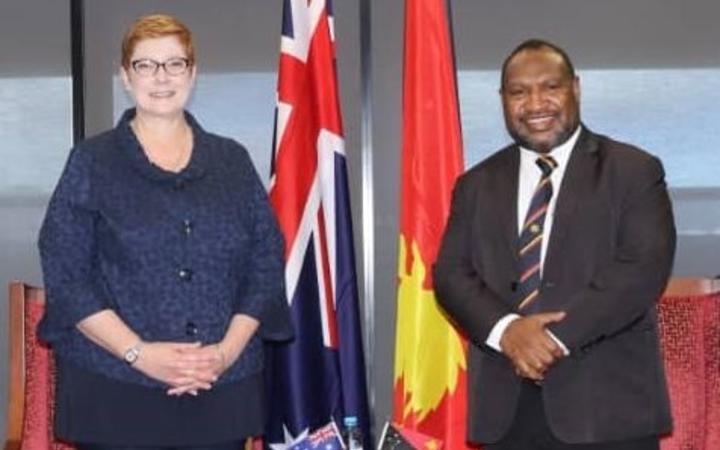
Marise Payne and James Marape.

Posted by Radio New Zealand

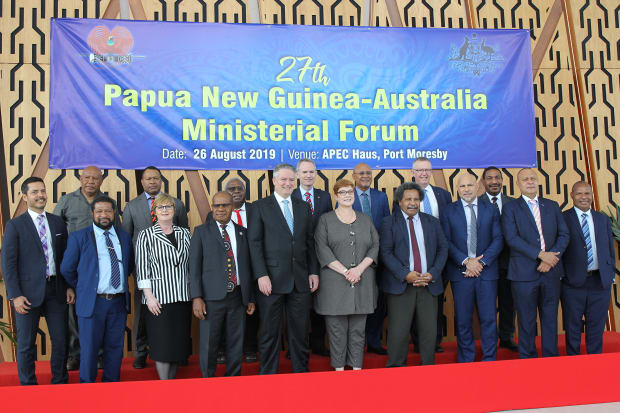
Australia is sending its largest ministerial delegation in more than a decade to Papua New Guinea as part of an annual bilateral forum.

The Foreign Affairs Minister Marise Payne is leading the group of six cabinet ministers to take part in the 27th PNG-Australia Ministerial Forum today.
Ms Payne will co-chair the forum alongside her PNG counterpart Soroi Eoe.
The forum follows a July visit by PNG Prime Minister James Marape to Australia and comes hot on the heels of the Pacific Islands Forum meeting in Tuvalu where Australia's interaction with regional leaders was controversial.
After the meeting Australia was called condescending by a number of Pacific leaders and its attitude was described as "neo-colonial"
However, Ms Payne said Australia's relationships with its Pacific neighbours remained deep and strong.

Australian loan aims to keep Marape happy


By Phillip Coorey and Andrew Tillett - Financial Review

The Morrison government is set to extend a short-term loan to help Papua New Guinea refinance its debt, as the Pacific neighbour threatens to go to China or elsewhere for assistance.

A delegation of six ministers, including Finance Minister Mathias Cormann and Foreign Minister Marise Payne, visited Port Moresby on Monday for talks, less than a week after PNG said publicly it wanted $1.5 billion from Australia.

It is understood PNG Prime Minister James Marape has walked back that number to about $300 million.

A senior government source said that while normally such countries would go to the World Bank or IMF looking for loan assistance, there was "a time issue'' involved, meaning PNG was in a hurry and would go to another country for the money.

Mr Marape confirmed this, telling the ABC: "Whether it is China, India or Australia – the cheapest help that we can get and the best help that we can get in terms of the loan – I'm in the business of refinancing my entire loan portfolio."
A government source said helping PNG via a loan was preferable because there would be no impact on the budget bottom line.
Canberra is open to considering PNG's request, with officials noting that Mr Marape, who became Prime Minister in late May, has emphasised making PNG more economically independent and improving trade relationships.
However, any loans would likely be offered on the proviso of PNG undertaking economic reforms, while long-term financing options also include the Asian Development Bank as well as the World Bank and IMF.
Lowy Institute Pacific Islands program director Jonathan Pryke said PNG's economy had been struggling since 2014 when a collapse in oil and gas prices meant resources projects did not deliver revenue, forcing the government to borrow to plug the budget hole.
The government owes 27 billion kina, or $11.8 million, with public debt making up about 30 per cent of its gross domestic product.
With PNG emerging as a battleground between Australia and China for influence, Mr Marape's office earlier this month said the government had asked Beijing for assistance with its debt but he later back-pedalled and gave assurances that other partners had been asked to help.
"It's been a slow-moving crisis for PNG. They've found it very heavy going to rein in expenditure and implement austerity over the last couple of years," Mr Pryke said.
He said PNG had borrowed at high interest rates from domestic banks and refinancing its loans would ease the strain of debt repayments, which now made up 15 per cent of government expenditure.
Interest on domestic treasury bills is 1.97 per cent for 63 days and 5.3 per cent for 364 days, while bonds are 8.1 per cent for two years and 11.98 per cent for 10 years.
But a stumbling block had been Port Moresby's unwillingness to undertake reforms, Mr Pryke said.
The World Bank had provided $US150 million ($222 million) but PNG's inadequate performance had led the bank to hold back on the second tranche.
The delegation of ministers, which also included Defence Minister Linda Reynolds, Pacific Minister Alex Hawke, Immigration Minister David Coleman and Assistant Trade and Investment Minister Mark Coulton, is the biggest Australian contingent in more than a decade to visit PNG.
Talks also progressed on elevating the relationship between PNG and Canberra to the status of a Comprehensive Strategic and Economic Partnership, with an agreement expected to be signed later this year.


Go to this link for more: https://www.afr.com/politics/federal/australian-loan-aims-to-keep-marape-happy-20190826-p52kp8

Tuesday, August 20, 2019

PNG seeks $1.5 billion loan from Australia


By Angus Grigg - Financial Review

Papua New Guinea is seeking $1.5 billion in loans from Australia to help fund government spending programs, just weeks after floating the idea of China refinancing its entire national debt. Commerce Minister Wera Mori said the proposal was raised with Treasurer Josh Frydenberg at a meeting on Monday.

“I would like to see it [the loan] done by Australia alone, but if not Australia could take the lead,” he told The Australian Financial Review on the sidelines of a conference in Sydney.

“Australia has always been our friend, where else can we go.” Mr Frydenberg declined to comment but confirmed he had met with PNG's Treasurer Sam Basil.

In recent years Australia has balked at providing budget support to PNG since ending the practice in June 2000 and concentrating on direct funding of aid programs.

Since then Canberra has typically worked through multilateral organisations such as the World Bank or the International Monetary Fund when helping to finance budget support programs.

Such a reluctance to intervene directly may have eased in recent years as China looms larger as a strategic competitor in the Pacific and the Morrison government seeks to re-focus on the region as part of its “Pacific step-up”.

PNG last requested financing support from Australia in 2017, when the former government of Peter O’Neill sought to have Australia’s entire $558 million annual aid program delivered in the form of budget support.

Canberra rejected the idea, with former minister for international development Concetta Fierravanti-Wells warning that “aid was not charity”.

Corruption has been one of the major concerns in providing direct budget assistance, but Mr Mori said the new government of James Marape was “stepping up the fight” in this area.

“We have demonstrated this by holding a commission of inquiry into the UBS loan and we are strengthening ICAC [Independent Commission Against Corruption]," he said.

Earlier, Mr Mori told the PNG Investment Conference that new loans were needed to shore up the budget and stabilise the economy.

“The new Marape/Steven government is looking for some type of assistance from the Australian government to stabilise the PNG economy and for budget support,” he said.

On the sidelines of the conference, Mr Mori indicated fresh funds would not be sought from China for budget support.

“I think we have too much exposure to China ... that’s just my personal view,” he said.

Earlier in the month a press release from Mr Marape’s office indicated PNG was seeking $11.8 billion from China to restructure its national debt.

But just a day later the Prime Minister sought to hose down any loan package from China, saying the statement was put out without his knowledge.

Mr Marape said PNG was seeking assistance from China along with others such as the World Bank and "non-traditional partners".

The PNG economy has faltered this year amid foreign exchange shortages and a lack of new resource projects, leading to government revenue falling well behind budget targets.

Stephen Howes, a PNG specialist at the Australian National University, said PNG's economic recovery in 2018 had stalled this year and the country continued to suffer from boom and bust cycles.

“To be sure, future-year prospects are better, with some important infrastructure projects underway and the Papua LNG agreement signed, though now under review,"  he wrote in a blog post on August 8.


Featured Post

Cashless in China as I study for my PhD

                                WeChat and Alipay digital payment applications By BETTY GABRIEL WAKIA - posted on PNG Attitude Blog PORT MOR...