By CLARISSA MOI - The National IT’S official. Internet rates for consumers using Telikom PNG and Bmobile have been slashed by between 70 and 80 per cent. In what is a landmark moment in the telecommunication sector, Communication and Energy Minister Rainbo Paita said the lowering of internet rates would facilitate “higher and more efficient communication among our citizens”. “We will now enjoy major reductions in fixed mobile data prices by the Kumul Telikom Holdings through its subsidiaries Bmobile and Telikom PNG,” he said. “On average, internet prices have been reduced by 70 to 80 per cent. “These are permanent price changes and not just a one-off campaign.” Paita said it was consistent with the Government’s plan to transform and grow the country’s economy, cultivate new practices and provide new jobs. “This massive reduction in rates will also involve higher and efficient communication among our citizens,” he said. Paita said information and communication technology was a cross-cutting enabler to transform the country economically. He said customers should expect continuous price reductions in all products including fixed internet services on fibre, assymetric digital subscriber line (ADSL) and fixed wireless broadband. “This reduction should encourage more Papua New Guinea citizens to start more small medium enterprises and businesses as well as enable increased productivity for existing companies. Telikom PNG began reducing its rates on Monday (July 1). Bmobile began at 12:01am yesterday (July 03). Telikom PNG’s 2GB (gigabytes) for seven days which previously cost K18 will now be K10. Bmobile’s 150MB (megabytes) for seven days was previously K10. It will be now be 2GB for K12. The new data rates for Bmobile are: 500 megabytes (MB) for one day for K3; 1 gigabyte (GB) for three days for K6; 2GB for seven days for K12; 10GB for 30 days for K55 and 20GB for 30 days for K150. Telikom PNG’s new rates are: 1BG for one day for K5; 2GB for seven days for K10; 20GB for 30 days for K95; 50GB for 30 days for K230; 100GB for 30 days for K450, and 200GB for 30 days at K875. Telikom PNG’s sales and marketing manager Silas Matoli said they expected an influx of customers given the reduction in internet cost. “With the current capacity, we are able to cater for the increased demand in bandwidth. But if there is any need, (obviously) we will go back to DataCo PNG Ltd which is the wholesale, to add on more value,” he said. Matoli said there would be a decline in revenue to the company but they had plans to cushion that. “We are looking at aggressively going into the market and getting all the market shares.”
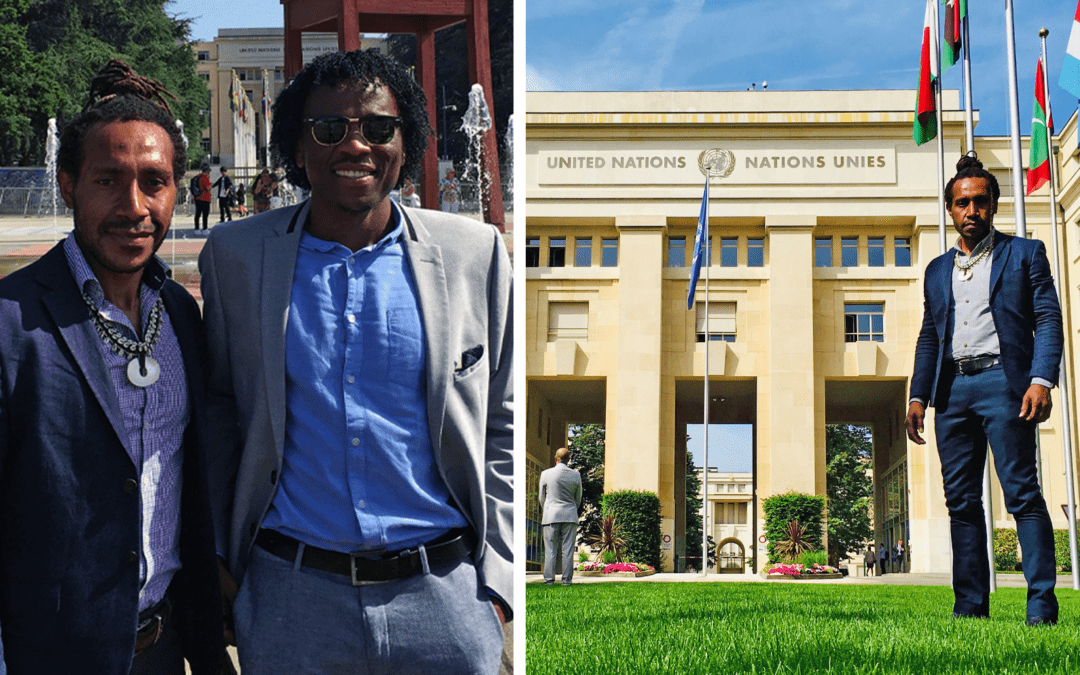
A resilient community from Port Moresby, Papua New Guinea’s capital city was represented by Human Rights Defender and Paga Hill youth leader, Allan Mogerema at the Human Rights Defender’s Advocacy Program (HRDAP) with the International Service for Human Rights (ISHR) from 17-28 June in Geneva, Switzerland. Mr. Mogerema delivered a joint statement at the 41stUN Human Rights Council.[1]
“My community is a pioneer informal settlement in Port Moresby. Once home to 3000 people our peaceful settlement was violently evicted and demolished. We were displaced in our own city between 2012-2014 at the hands of two Australian Corporations, Paga Hill Development Company (PHDC) and Curtain Brothers with the complicity of the PNG State,” claimed Mr. Mogerema.
A PNG Supreme court hearing was in favor of the community to stay on the foreshore as it fell outside the area of PHDC’s lease. However, just three weeks after the decision the final illegal eviction and demolition of the Paga Hill community took place[2]. As of today, PHDC’s ‘Paga Hill Estate’ project remains incomplete of its proposed marina, luxury hotels and apartments.
“This has been a violation of our rights under the UN Right to Adequate Housing[3], Economic, Social and Cultural Rights[4], Right to Freedom of Opinion and Expression[5] and Rights of Human Rights Defenders[6]. It is also a violation of our rights under the PNG Constitution[7].”
A ‘world class relocation package’ in terms of basic services was promised to the displaced community by the companies and PNG state but this never eventuated. There has been no compensation of their damaged properties and they have been displaced in the city with nowhere to go and are now living in very harsh conditions.[8]
“We have exhausted all the local existing remedies in Papua New Guinea.”
“Now in our 7th anniversary of the #Justice4Paga campaign, having a voice at the United Nations Human Rights Council’s 41st session at Palais des Nations, Geneva in Switzerland is a big step forward for my community.”
“I have felt like a refugee in my own country for the past 7 years, however, no matter how long it takes our community will get justice!”
Mr Mogerema participated in the training with former Manus detainee and Human Rights Defender Abdul Aziz Muhamat[9] who delivered a powerful statement blasting the Australian government at the Human Rights Council for the human rights crisis in Manus, PNG.
PAPUA New Guineans and businesses are already starting to enjoy cheaper and faster internet access in the country. This follows news that its 4,700km fibre-optic submarine cable is on track to be delivered by the end of the year. In the past, a 2Gb 14-day data bundle was retailed at K60. Today, a 30-day 10Gb data bundle costs only K55. This means Telikom PNG 4G subscription charges are down by about 80 per cent. Huawei Technologies (PNG) Pvt Ltd chief executive officer Jacky Xu, pictured, said: “Our vision is to deliver digital connection to every person, home and organisation for a fully connected, intelligent world. “That is why we believe that it is everyone’s basic right to be digitalised and connected in this modern era. “We are working hard here, hoping it (vision) will be realised in PNG. “As Bmobile’s strategic partner, we admire our customer’s huge investment in connectivity. “We are very honoured to be part of their mission towards a better connected PNG. “Moving forward, Huawei PNG promises its full commitment in contributing to PNG’s Information Communications Technology (ICT) development. “We will further increase our efforts and investment to enable our customers to enjoy the best and affordable network services, be it at home or an organisation.” In a recent panel discussion in Port Moresby, PNG DataCo Ltd general manager for commercial services Une O’ome said the 4G LTE (Long Term Evolution) platform cables being developed with Huawei would improve internet capabilities by 100 gigabytes per second (when completed and operational). “It will be much better in comparison to what we have today, combining different technologies like sattle-lite, the old APNG-2 (Australia PNG Two) cable going from Port Moresby to Sydney and what we have going on the PPC-1 (Pipe Pacific Cable One) in Madang,” he added. Go to this link for more: https://www.thenational.com.pg/country-already-enjoying-cheaper-faster-internet/
Prime Minister James Marape told Parliament today, the National Executive Council awaits the Attorney General's Office to appoint a team in its wisdom who will conduct the Commission of Inquiry into the Union Bank of Switzerland investigation report.
Marape had announced that a COI will be established to inquire the findings following the tabling of the UBS investigation report by the Ombudsman Commission last week in Parliament.
Marape told the house this morning, he is not afraid of the outcome and he would like to see the COI establish at the earliest and actions can be taken on those implicated.
Prime Minster James Marape made it clear he is willing to resign from office if he is in anyway implicated in the UBS loan saga.
He told parliament this morning that no stone will be left unturned during the Commission of Inquiry into the matter of the UBS loan.
The Prime Minister says the inquiry will begin with the political leadership all the way down the line to all that were involved in the UBS deal.
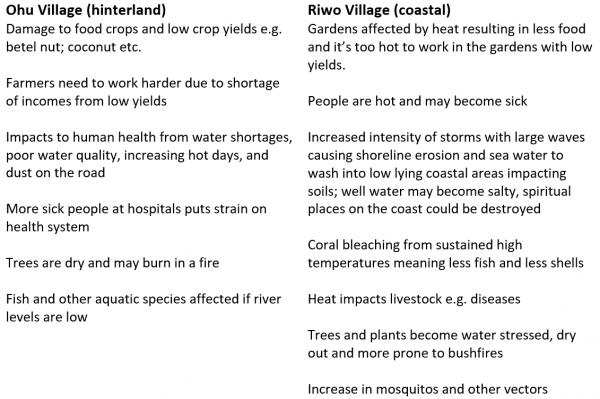
Changes in rainfall and rising temperatures were considered to be the most important climate variables. For example, residents of Ohu and Bundi reported experiencing changes in the frequency and intensity of rainfall, which have damaged the road to Madang town. An increasing number of hot days is also limiting the number of hours that women reported working in the garden. Residents of Hogave were overwhelmingly concerned about the potential for wildfires resulting from changed rainfall patterns and higher temperatures, particularly in the community forest conservation area. These changes have flow on effects to food security, human health and ecosystem health and function (Table 1).
Table 1: Concerns associated with increasing temperatures
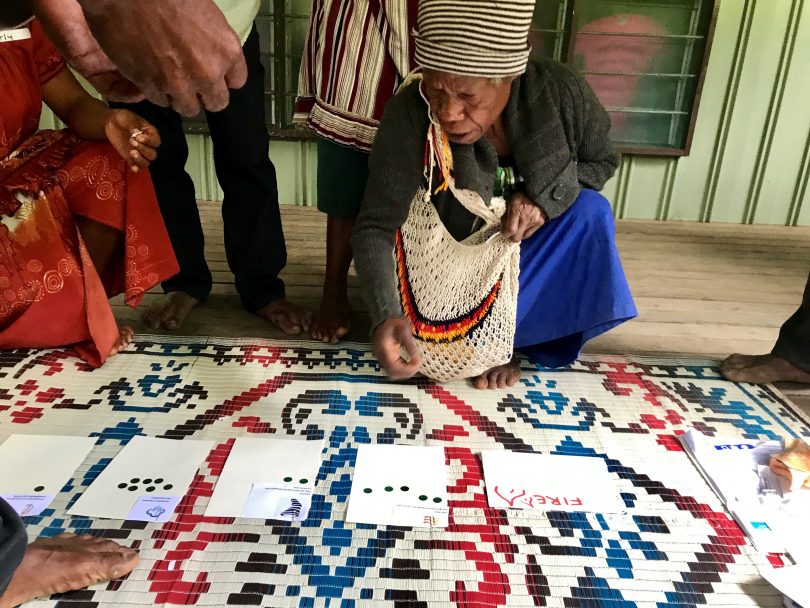
It was clear throughout the workshops that women and children are most disadvantaged by local environmental change. Female workshop participants were often most vocal about dimensions of vulnerability (e.g. population growth) and their links to social issues (e.g. alcoholism, domestic violence and petty crime) that they viewed as likely to be heightened through ecosystem decline. Currently, the migration of highlanders to coastal centres seeking employment is viewed as contributing to the loss of local ecosystem services. For example, in the coastal village of Riwo, participants attributed land use conflict and a lack of bush materials for construction of houses to local population change. When coupled with sea level rise, which erodes the community’s land, a vicious cycle might result which heightens demand for unsustainable economic development and over-extraction of natural resources.
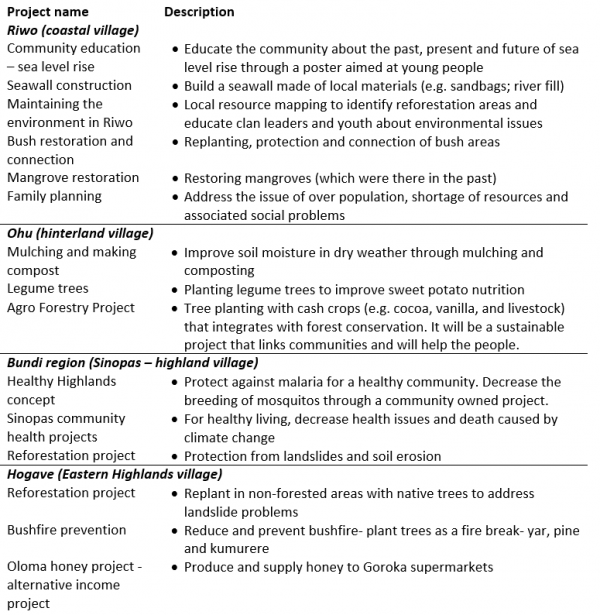
To address impacts of concern from climate change, workshop participants were asked to develop project plans, using a simple template that called for them to consider collective action, at the scale of the village ( Table 2). These projects addressed typically place-based, direct environmental impacts, but also impacts of issues such as population growth and migration indirectly linked to ecosystem change through the need for economic development.
Table 2: Community project plans to address impacts of climate change
While members of the community expressed considerable enthusiasm to promote collective action, they nevertheless voiced concerns about a lack of resources (financial, knowledge and equipment) to implement these plans that, if not addressed, would likely result in little progress.
As a final phase to our project, we brought together, in a workshop setting, members of each of the communities with representatives of their respective governments, at provincial, district and ward levels. The aim of these workshops was to establish connections between government and communities for exchange of information on the community’s need for assistance with adaptation, and any resources that might be available through existing government programs.
Although we were able to match some projects to provincial government programs in agriculture and reforestation, an important limitation noted by government representatives was the absence of a functioning provincial office of climate change. In Madang Province the government has established a Provincial Climate Change Committee however it has no resources and currently is actively supported only by the agriculture agency. Biodiversity conservation and climate change adaptation are seen as cross-cutting policy issues that require cross-division policy and planning. Issues of governance, such as a lack of funding or funding delays, leadership and administrative instability, and communication weaknesses to other layers of government, were identified by government staff as obstacles to effective action and must be resolved for successful adaptation to climate change and biodiversity conservation in PNG.
The Engaging Communities and Government in Biodiversity Conservation and Climate Change Adaptation project is made possible by the generous support of the American people through the United States Agency for International Development (USAID).
Enough talk. Ensuring equal participation in politics is a challenge the new Marape government must rise to meet.
The last few months in Papua New Guinea’s politics have been described as political “chaos”, “turmoil”, “upheaval”, “crisis”. The Australian newspaper even went so far to describe PNG as a “potentially disintegrating neighbour.” For Papua New Guineans, it was a mere harkening back to a telling characteristic of the national political scene
PNG politics has always been robust and has always been a “haus man” or “boys club”. For many, especially women, the takeaway lesson from the recent political game-playing, is that there is a dire need for women in PNG politics and it needs to start now.
In her 2013 thesis entitled, “Women and Politics in Presence: Case of Papua New Guinea,” Mary Fairio, a gender researcher at the PNG National Research Institute (NRI), explores why PNG is one of the countries with the lowest number of female representatives in parliament. PNG currently has no women in parliament despite a constitution that enshrines human rights and identifies a national goal of “equality and participation”.
A 2002 presentation by PNG academic and gender specialist Orovoe Sepoe asked the following questions:
Would women’s entry into the legislature help improve governance, democracy and development outcomes?
What difference would women make to the current state of public affairs?
There have been numerous studies and papers undertaken to answer these questions both internationally and domestically in PNG. It seems it is not enough that the fact that a democratic state identifies itself as such should require adequate representation of one half of its population. Women bear the additional burden of illustrating how they add value to the system.
Kila Kila Village Court outside Port Moresby in 2011 (Photo: DFAT/Flickr)
Therefore, the pertinent question to be determined is “why is it difficult for women to be elected in PNG?” Fairio’s thesis points to both the structural system in PNG that limits the ability of women to enter politics as well as social, cultural and economic factors.
Structural changes can be addressed almost immediately and whilst social, cultural and economic changes take time, they benefit from, and can be instigated by, structural change. That is the challenge for PNG’s new Marape government.
There have been several major proposals, over the last decade, for structural change in PNG to allow for greater participation in politics by women.
In 2009, Dame Carol Kidu as then Minister for Community Development in the Somare government, and the only woman in parliament, attempted to utilise section 102 of the Constitution to nominate three women to parliament. However, section 102 required a two-thirds absolute majority vote and it did not receive that support.
In 2012, Kidu again attempted to effect structural change with a proposal for 22 reserved seats for women through the Equality and Participation bill. The proposal had the support of the then Prime Minister Peter O’Neill and received much media publicity. However, although it passed the first reading, generating much excitement, it failed to pass a subsequent parliamentary reading and was later abandoned.
The 2009 and 2012 proposals are what are known as temporary specials measures or TSM’s and this is what the NRI have been encouraging through the work of its “Gender in PNG” program, headed by Fiona Hukula and Elizabeth Kopel.
Patrick Kaiku, a lecturer in politics at the University of PNG, wrote that the failure of the 22 reserved seats was in large part due to the misunderstanding amongst members of parliament as well as the public as to why the proposal was needed. Kaiku argued that much of the rhetoric surrounding the bill was “men versus women” and that there needed to be more awareness and consultation with the public to create public ownership of the bill.
PNG journalists covering the APEC summit in 2018 (Photo: Shane McLeod)
There are two current proposals on foot for women’s representation in parliament. Alphonse Gelu, the Registrar of Political Parties, has been lobbying the Government since 2017 to pass proposed changes to the Organic Law on the Integrity of Political Parties and Candidates (OLIPPAC). One of the proposals in the revised organic law is that 20% of the total number of candidates nominated by a political party must be women. Gelu has written extensively in the national papers as to why his office has proposed these changes to the OLIPPAC.
Additionally, in February last year, the government directed the PNG Constitutional and Law Reform Commission (CLRC) to review the Organic Law on National and Local- Level Government Elections. The direction came with 12 terms of reference, the fourth of which was “women and special interest representation in Parliament”. The CLRC, currently led by Dorothy Mimiko-Kesenga (Secretary) and Michelle Taumpson (Deputy Secretary), completed a consultation process and its report is now at its finalisation stage.
In March 2019, before losing his prime ministership, O’Neill announced that at the next national elections in 2022 there would be a measure in place for four women to be appointed as regional representatives based on their electoral positioning in their contested electorates (a concept already in effect in the Autonomous Region of Bougainville). The legislative framework that would enable this measure was not announced but is perhaps something we can expect from the CLRC report.
What is clear from all of this, however, is that much work has already been undertaken by government bodies, private institutions and independent researchers and commentators, many of whom are PNG women, and that viable proposals are readily available. What is missing is the political will.
If the Marape Government is serious about creating the “richest black Christian nation,” women must be equal participants because, as the United Nations describes it, “democracy needs women in order to be truly democratic, and women need democracy if they are to change the systems and laws that preclude them, and preclude societies as a whole from attaining equality.”
ZURICH - UBS Group AG, Switzerland's largest bank, has commented on the K4 billion loan granted to Papua New Guinea that contributed to political upheaval still resonating today.
The multinational investment bank and financial services company has a presence in all major financial centres has issued a brief statement outlining its view of the case.
Five years ago, UBS granted a loan worth US$1.2 billion (K4 billion) to PNG, which used the money to buy a stake in petroleum company Oil Search.
The deal went wrong as the oil price fell, forcing the PNG government to sell the shareholding at a loss.
Since PNG’s prime minister Peter O’Neill was replaced two months ago, his successor James Marape has ordered a thorough review of the case.
UBS said it welcomed Marape’s move to establish a commission of inquiry into the loan.
The bank said this will provide a welcome opportunity to independently evaluate PNG’s strategic investments.
UBS added that a report by the country's ombudsman had revealed nothing untoward on the part of either the bank or its employees.
It said the loan had been granted in 2014 in accordance with local rules and regulations.
UBS said an experienced local law firm, Ashurst, had been part of the negotiations at the time.
The government had also received further assistance from KPMG and Norton Rose Fulbright, a global law firm.