Monday, July 8, 2019

Row over top post


By CLIFFORD FAIPARIK - The National

POLICE Minister Bryan Kramer, on legal advice from State lawyers, has instructed Gari Baki to vacate the police commissioner’s office as his contract had expired in May.
He has appointed Deputy Commissioner Francis Tokura, currently the Bougainville Police Service commander, to be the acting police commissioner.
Tokura will be assisted by assistant police commissioners Joanne Clarkson (administration) and Peter Guinness (operations).
Kramer said Baki’s contract had expired on May 7 thus “he was illegally in office” as there had been no gazettal notice authorising him to act in the position.
“I got the advice from the Attorney-General’s office (last) Thursday and that made me instruct him to leave the office (last) Friday,” he said.
He informed Baki in writing.
“My letter to him was based on the advice I got from the Attorney-General’s office. The advice was that there was no existing appointment (to let Baki continue as commissioner),” Kramer said.
“Former Police Minister Jelta Wong never extended his (contract in an) acting position. Baki himself told me that the National Executive Council had never reappointed him. He made reference to some gazette notice which I’m not aware of.”
Kramer also welcomed Baki’s plan to take the matter to court.
“Even he goes to court, that would not put him back in the office,” he said.
“He is over the (retirement) age and he is no longer a member of the force.”
Kramer said the terms for deputy police commissioners Raphael Huafolo (administration) and Jim Andrews (operations) expired on July 4.
“He (Baki) himself issued the notice that both his deputies’ contracts have expired.”
Meanwhile, Baki plans to take the matter to court.
“The reason for my decision is because as far as the senior police leadership and I are concerned, due and established processes for appointments were not followed by Police Minister Bryan Kramer (in the appointments of Tokura, Guinness and Clarkson),” Baki said.
“At the outset, let me state for the record that this action is not intended in any way to discredit the three officers who have been appointed in acting capacities.
“They are experienced police officers who are more than qualified to occupy these offices.
This action is taken to protect them as well as the other senior officers of the constabulary.”
Baki questioned why the Government did not appoint Tokura, Clarkson and Guinness to substantive positions instead of in acting capacities.
“All appointments whether temporary or substantive shall be made by the Head of State, acting with and in accordance with the advice of the National Executive Council given after consultation with the Public Service Commission and any appropriate Permanent Parliament Committee, which in this case is the Permanent Parliament Appointments Committee,” he said.

Go to this link for more: https://www.thenational.com.pg/row-over-top-post/

Gulf gets K3mil LNG payment


By LUKE KAMA - The National 

FINANCE Minister Charles Abel, pictured, presented a development levy of K3.9 million from the PNG LNG project to the Gulf government in Kerema on Friday.
The payment to Gulf Governor Chris Haiveta was a replacement for an earlier government cheque issued by the Finance Department but was refused by the bank due to insufficient funds in the account.
Abel, former deputy prime minister and treasurer, said there was so much money coming into the country from the extraction of the oil and gas, particularly the PNG LNG project, but all the money was not factored into the national budget every year.
“These monies are tied to Kumul Petroleum Holdings Ltd and these are some of the legacy issues that I have been talking about for change in the previous government,” he said.
“We need to have that money factored into the annual budgets so that we are able to finance projects and programmes and deliver much-needed services to our people.”
Abel said the former prime minister Peter O’Neill had done a lot of good things for the country, but at the same time he did a lot of bad things too.
“But we must not dwell on the past,” he said.
“We have a new government, a new, young and vibrant prime minister in James Marape and I stay committed to support his visions for the good of our people and our country.
“Because as a leader, I have always maintained that what I do at the national, provincial and in my district is to ensure our people are served well.
“That’s all I want and I have no other interest for myself or whatever.”
Abel reiterated that the Papua LNG project was very important for the people and the country that would generate enormous benefits and it was very important too that all stakeholders and project partners worked together to ensure the project came to fruition.

Go to this link for more: https://www.thenational.com.pg/gulf-gets-k3mil-lng-payment/

Outpouring of support in plea for survival of PNG literature


Related image
By KEITH JACKSON - PNG Attitude
NOOSA – A huge number of friends of Papua New Guinean literature - authors and readers from around the world - have signed a manifesto drafted by Phil Fitzpatrick asking prime minister James Marape to commit his government to provide support and recognition for PNG writers and literature.
This morning 150 people had shown their support, with many not only signing but offering reinforcing comments for the Marape government to consider.
The manifesto is the centerpiece of a petition organised by Caroline Evari that will be handed to Mr Marape and other senior politicians in the PNG parliament in an effort to provide home-grown literature with a solid foundation.
The manifesto seeks to stimulate meaningful, tangible and scaled up governmental and institutional support for PNG creative writing by influential people who will understand, endorse and support investment in literature as a transformative force in PNG society, education, culture and nation-building.
The truth is that the renaissance of PNG literature that began in 2011 is running out of steam and is in danger of stalling.

“Without an indigenous literature, how can Papua New Guineans know their own history and tell their own stories?” asked former kiap, senior Australian health bureaucrat and PNG Attitude commentator, Chris Overland.
“The creation of a body of indigenous literature is a prerequisite for the nation to be able to discover and define itself as something greater than its constituent parts,” Mr Overland said.
And writing from Barengigl High School alongside the treacherous highlands road that runs to Mt Wilhelm from Kundiawa, principal Roslyn Tony said, “we need our own home grown literature to keep the past and present alive in pen and paper”.
I visited Barengigl in March 2017 and told an audience of the entire school that their new principal, Ms Tony, just had an essay and a poem published in a book, a Papua New Guinean book.
I then extracted from my bilum a brand new copy of My Walk to Equality, which was to be launched in Port Moresby a few days later, and presented it to a delighted Ms Tony.
The school gave a Chimbu yodel that reverberated back and forth among the surrounding lofty mountains. The  new principal had been published in a book, the book was here in Barengigl and this was cause for excitement and joy. 
We also heard from Chimbu social welfare advocate, Philip Kai Morre, who said:
“Having books in schools is important to increase intellectual ability. Books transmit knowledge and wisdom. The education department needs to buy books produced by local writers.”
I couldn’t agree more. Those books exist (Pukpuk Publications has alone published over 50) but getting them into schools, libraries and people’s hands is an extraordinarily difficult and costly task.
“I support this manifesto,” wrote Richard Dinnen from Cairns, Mr Dinnen was the ABC’s PNG correspondent from 1999-2001.
“More than any nation, Papua New Guinea needs to develop written story-telling," he said.
“It frustrates me how little there is about PNG in books and literature. You have great stories, and PNG people are great story tellers. Do it now. For your country, your children, your future. Tell your stories - develop a thriving literature.”
From Port Moresby, author Baka Bina wrote:
“Gavman mas sanap wantaim yumi long kisim olgeta rait bilong mipela.” [The government must support us by purchasing our works]
“Ol man igat stori i dai isi isi igo na ol yanpela bai nogat moa stori long rit na kisim save bilong mipela yet long Papua Niugini.” [The people with the stories are gradually dying and younger people don’t have the stories that will give knowledge to us Papua Guineans]
“Sapos dispela tingting long noken givim tingting na sapot long ol lain bai rait holim pain na stori bilong mipela, mipela bai lusim pes na luk olsem ol mahn nogat hausman.” [If there is no support for authors and our stories, a significant amount of our culture will be lost]
“History is stories. Writers write stories. A nation is invisible if its stories are (perhaps) being written and yet not available to be read. Writers and readers together imagine a nation," said friend of PNG literature, Wendy Glassby.
And Francis Nii – the prominent Papua New Guinean author, editor, publisher, commentator & literature advocate – wrote:
“Literary excellence is the key to unlocking the hidden treasures of life. We as writers and publishers are solving the writing and production issues. But schools do not have funds to buy books and do not get them unless they are made available free of cost.
“There is a disappointing lack of support both from the government and aid donors to supply PNG-authored books.
“Stories are part of our culture; books are repositories of our culture. What is it that the authorities don't understand? A nation without literature is a people with lost identity.
“Can the current government, under prime minister James Marape, embrace national literature and PNG-authored books in his government's mission of making 'PNG the richest black Christian nation' by giving PNG authors and their work special recognition and supplying their books to schools around the country?”
Social commentator, journalist, author and self-described traditionalist, Daniel Kumbon from Enga, said he feared “so much of PNG’s rich traditions will be lost if not recorded down in whatever form”.
And former vice-chancellor of the University of Technology, Dr. Albert Schram, now living in Verona, Italy,  said:
“Writing is thinking, and reading is feeding the mind.
“We all have an interest in supporting PNG literature, which will help forming confident citizens with a strong sense of identity.
"Those type of citizens will be able so successfully interact with the rest of the world, and not become its victims.”
“This country needs to invest in its own literature,” poet Caroline Evari told us. “Instead of diverting money into foreign material and making the rich become richer overnight, let’s invest in our own writers and authors.
“Let’s encourage the publication of our stories, cultures, traditions and languages as a way of preserving our heritage which will soon disappear. Most importantly, let’s fill our libraries with PNG authored books and have a bookshop that is dedicated to publishing and selling PNG books only.”
And finally, to end these extracts of the many comments received at PNG Attitude, my great friend Corney Korokan Alone, a public affairs commentator who describes himself as “a thinking and patriotic citizen of beloved Papua New Guinea advocating for a better educated citizenry”, said:
“I firmly believe that we will create a smart, healthy and wealthy Papua New Guinea, an economic powerhouse that is driven by confident, professional, patriotic, tenacious and altruistic entrepreneurs, educators and role models in every space who are community centered.
“In doing so, we will lift up others along the way with that ladder of opportunity.
“To do that, we must articulate our own destiny. Tell our own stories clearly. PNG-born artists and writers who are able to differentiate the fluff and falsehoods that gets pushed down and absorbed without questioning and second thoughts. We must see that clearly and chart our paths.”
Exactly.

Go to this link for more: https://asopa.typepad.com/asopa_people/2019/07/over-100-voices-speak-up-in-plea-for-more-support-for-png-literature.html

Thursday, July 4, 2019

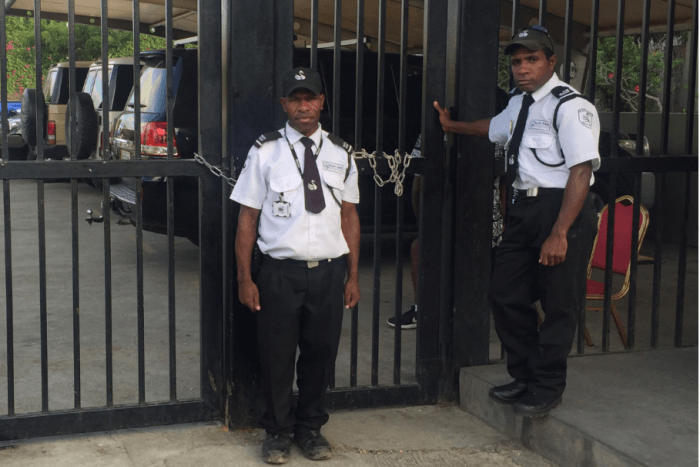
Part of the solution or part of the problem? Private security in PNG


By Sinclair Dinnen & Grant Walton - DevPolicy Blog

In a surprise move, Papua New Guinea’s (PNG) new Prime Minister, James Marape, has appointed member for Madang Open Bryan Kramer, as the country’s police minister. Soon after his appointment Kramer promised to reform PNG’s police force, the Royal Papua New Guinea Constabulary (RPNGC). The one-time member of the opposition and critic of the O’Neill government, has outlined a range of measures, including providing more opportunities for women, addressing corruption and improving discipline. He is also encouraging citizens to report crime and police misdeeds through social media, which has already resulted in an arrest.
While Kramer’s promised reforms are encouraging, improving security in what is often depicted as one of the world’s most dangerous countries will not be easy. PNG’s police force is massively understaffed, poorly resourced, ill-disciplined and heavily factionalised. Even if reform were to improve the state’s police force, PNG’s serious fiscal crisis means that Kramer, and the still-to-be-appointed new police commissioner, will need to look beyond the RPNGC to find answers to PNG’s security problems.
One possible place to start looking will be PNG’s private security industry, which although intersecting with many areas of public policing has been largely ignored in policy and development discussions to date.
The private security industry has become the largest provider of security in the country. According to PNG’s Security Industries Authority (SIA), which is the designated regulator under the Security (Protection) Industry Act 2004, the number of licensed companies grew from 173 in 2006 to 464 in 2016, with a total workforce of around 27,709 security guards. These official figures don’t include what are believed to be the much higher number of unlicensed security companies and personnel operating in different parts of the country. However, the number of licensed guards is still well over three times that of serving police officers and exceeds the combined strength of PNG’s three ‘disciplined services’ – the RPNGC, PNGDF and correctional service. The industry is a major employer, with some claiming that it is now the country’s third largest source of employment. While available figures are rubbery, the SIA estimated the value of the industry in 2016 as between PNGK833 million and PNGK1 billion.
Companies come in all shapes and sizes and provide a range of services. They include local offices or franchisees of transnational security corporations with global reach, well established foreign and locally-owned firms, through to a plethora of smaller entities operating in particular areas. In addition to static guards, services include personal protection, training, assessment, rapid response, tracking and surveillance.
Industry growth reflects high levels of insecurity and fear of violent crime, combined with declining confidence in PNG’s state police. Household victimisation surveys confirm that lack of trust in the police is a major contributor to insecurity in urban areas, while regular surveys of businesses have produced similar finding, as well as documenting the steady rise of investment in private security. According to the World Bank, this investment is higher in PNG than the average for both the Sub-Saharan Africa and Latin America regions.
While acknowledging this reality is needed to improve security outcomes for PNG’s more-than 8 million citizens, there are three key challenges in attempting to engage with private security organisations.
First, private providers are highly exclusionary. The industry is most visible in PNG’s rapidly growing towns and cities, where government, business, and private wealth are concentrated. PNG’s prolonged natural resources boom in recent years has been a catalyst for growth, with a number of companies also operating in rural areas where the major extractive projects are located. PNG’s hosting of APEC in 2018 provided another major, albeit temporary, boost to the industry. As illustrated by the Paladin case, Australia’s off-shore detention facilities on Manus island have been a particularly lucrative opportunity for a succession of private security companies. In other words, these providers currently privilege powerful state and business interests over security of ordinary citizens. Re-incentivising private providers to improve public security will not be easy and, indeed, might prove to be an insurmountable challenge.
Second, the industry is poorly regulated. As well as reputable companies, both foreign and locally-owned, the industry has attracted its fair share of cowboys and fly-by-night operators. PNG presents a particularly challenging environment for those companies that strive to operate by the stated rules. Fierce political rivalries and nepotism play a significant role in decision-making around the allocation of government and other major contracts. The more established companies strive to do the right thing and have been lobbying government for a more transparent and effective regulatory framework. For others, however, playing by the unspoken rules of the political game remains a more attractive and profitable option.
Finally, although extensive interaction between police and private security occurs in practice, there are concerns around encouraging further collaboration. These include sensitivities about private providers encroaching further on areas that many believe should remain the exclusive preserve of public police; concerns that the growing prominence of private providers diverts attention away from the need to strengthen the police; and perceptions that public-private security collaborations tend to privilege business interests over those of ordinary citizens.
While there are many potential risks, policymakers would benefit from better understanding this burgeoning sector. As attested by its global growth, private security is here to stay. In acknowledging the inherently plural character of security provision in PNG, policymakers should explore whether the strengths within the private security industry might compensate for the weakness of the RPNGC, and vice versa. For example, PNG’s police could benefit from better access to the resources, skills, technology and intelligence of large private security companies. The RPNGC and private firms already cooperate informally. Could the industry and government develop regulatory and operational frameworks that allow police and private firms to work together under certain circumstances, with mutual benefit for both?
Ultimately, our focus needs to be on improving security outcomes for all Papua New Guineans, including its most vulnerable citizens. While seeking to strengthen the struggling police remains a critical priority, exploring other options in PNG’s fluid and changing security landscape should not be denied because of a narrow devotion to one institutional form.

EC needs K4.56mil for Hela provincial recount


Posted by The National

THE Electoral Commission will need K4.56 million to conduct a recount of the Hela provincial seat as ordered by the court, says Commissioner Patilias Gamato.
Gamato said the recount could start as early as July 9 in Tari if funds were secured.
“Hela is a challenging place and will require some security deployments,” Gamato said in a statement.
“The judicial recount will be done in Hela. However, if there are security threats, I may consider moving the counting to Mt Hagen (Western Highlands).” The seat was won by Philip Undialu in the 2017 general election.
Last Friday, the National Court ordered a recount after upholding the election petition filed by runner-up Francis Potape on the grounds of errors and omissions and illegal practice.
Justice Joseph Yagi was satisfied that petitioner Potape had successfully demonstrated that the result of the counting of the seat on July 23 2017 had been subject to tampering or manipulation which could have affected the result of the election. The court ordered the Electoral Commission to appoint an impartial and neutral returning officer, assistant returning officer and counting officials for the exercise.
The court also ordered that the recount be conducted within 30 days from the date of the order – June 28 2019.
Gamato said they did not have much time left.
“We have to start immediately. I have written to the Secretary for Treasury and Finance to identify some funds and allocate to the EC so that we can start the judicial recount as soon as possible.”
“If funds are secured, I expect the staff to be deployed over the weekend so that the judicial recount could start as early as Tuesday next week, 9 July 2019 in Tari.”
Meanwhile, Gamato has appointed the election manager for National Capital District Terence Hetinu as returning officer and Desmond Timiyaso, election manager for the Autonomous Region of Bougainville as assistant returning officer.

Go to this link for more: https://www.thenational.com.pg/ec-needs-k4-56mil-for-hela-provincial-recount/?fbclid=IwAR2jKDR-cRDNiRPTg5eIy4WsnR1ZO-JhVF41jCUziE4o8nkliB6jljriXcM

Writers of PNG - Now is the time to look your govt in the eye

CrocPHIL FITZPATRICK
TUMBY BAY - Perhaps the time has come for the writers of Papua New Guinea – authors, journalists, poets, commentators and others including publishers and illustrators - to look your government in the eye and make a statement.
Perhaps it is time to petition prime minister James Marape and other ministers and seek the government’s support for an authentic and home-grown Papua New Guinean literature - a literature that will help turbo-charge the serious nation-building task that lies ahead.
I propose here a draft form of words that can be sent to Mr Marape, together with the names of all the writers and readers who believe that PNG literature needs more than a thumbs up, it needs real practical support.

________
A Manifesto for Literature in Papua New Guinea
We, the writers of Papua New Guinea, believe that our nation’s literature is something that needs to be encouraged and supported by everyone, but especially by the government.
Without a home grown literature the story of our great nation cannot be told.
If our story is not told, future generations of Papua New Guineans will not be fully aware of where they come from, who they are and what made them.
A nation without a story is like a nation without a soul.
The writers of Papua New Guinea are currently struggling to tell our nation’s story.
There are no major publishers in Papua New Guinea interested in publishing our work. If we want to publish our books we have to pay for it ourselves.
Our books are not available in schools. The students of Papua New Guinea cannot read books written by their own countrymen and women.
Instead, they have to read books written by writers from other countries.
Papua New Guinea has a poorly resourced public library system. Few of our own books are available in these libraries. In most cases Papua New Guinean authors have to donate books free of charge to libraries so people can read them.
Our national literary award, the Crocodile Prize, is struggling to survive. It is supported by limited private funding. The Papua New Guinean government has never shown real interest in supporting it. Nor has the government shown an interest in supporting Papua New Guinean writers.
It is time this situation changed.
We, the undersigned writers of Papua New Guinea, are calling upon our new Prime Minister, James Marape, to commit his government and future governments to providing the support our writers, our literature and our nation deserve.
It is time to secure the story of Papua New Guinea for present and future generations.
To do less is unthinkable.

Go to this link for more: https://asopa.typepad.com/asopa_people/2019/07/writers-of-png-now-is-the-time-to-look-your-govt-in-the-eye.html?fbclid=IwAR1O3T1pbAgtvGDtvT2dJDdMHZ_k7WjHuJE-r4IyNmm9nNomL2usMfkzq5M

Resources industry & leadership change in PNG: some insights

Sarah Kuman
Sarah Kuman is a partner with Allens Lawyers specialising in corporate and commercial advice and natural resources law
By SARAH KUMAN | Allens
PORT MORESBY - James Marape's ascension to the Prime Ministership of Papua New Guinea brings potential changes to regulation of the resources industry.
We examine his new-look cabinet and some of the more recent ministerial comments regarding both region-specific projects and the resources industry more generally.
On 30 May 2019, James Marape became Papua New Guinea's new prime minister, following the departure of former prime minister Peter O'Neill.
Mr Marape has since foreshadowed potential changes to the regulation of resource projects in the medium term, while at the same time reassuring those with existing investments in the country.
Mr Marape was previously Mr O'Neill's minister for finance, but resigned in early April, triggering a series of defections which ultimately led to Mr O'Neill's resignation.
In resigning, Mr Marape cited policy differences with Mr O'Neill, including in respect of local business participation in resource projects and amendment to resource laws. His resignation came two days after execution of the project agreement for a significant new LNG project for the country.

Mr Marape is the member for Tari Pori, in the gas-rich highlands province of Hela, where parts of the PNG LNG Project are located. Mr Marape received a Bachelor of Arts from the University of Papua New Guinea in 1993, with honours in environmental science.
Mr Marape will remain prime minister until the next national elections scheduled for 2022, unless he resigns or is replaced before then.
This period will include (in October 2019) the holding of the independence referendum in the resources-rich Autonomous Region of Bougainville. The result of the referendum will be closely watched by other resource-rich provinces like Hela.
In his maiden speech to parliament after being elected, Mr Marape foreshadowed changes to the country's resources laws:
“At the moment our resource laws [are] outdated, we do not intend to chase [out] investors, they are here to stay, we encourage them … But we will look into maximising gain into what God has given this country, from our natural resources.”
Mr Marape continued in subsequent comments to reporters:
“We're not here to break legally binding project agreements but those project agreements must be sanctioned by law, if they have every tick ticked off, as prescribed by laws governing our nation, then they will stand the test of scrutiny. But if we find that any project agreement … or any project for that matter that has not fully prescribed provisions of law, then we are open to review and scrutinising it.”
In his address to the nation of 5 June 2019, Mr Marape struck a similar conciliatory tone, seeking to reassure investors while at the same time foreshadowing significant changes to resources laws in the future:
“I do not intend to harm our investors. Genuine investors in our country are very, very welcomed. They have been with us for a long, long time and without them we will not be where we are as a nation.
“I am speaking very, very strongly to gain more for our country… When I am speaking on natural resources, many of our corporate citizens amongst us will feel a little bit doubtful, intimidated and insecure, but you must not feel that way….
“I am in the business of making huge decisions in as far as the resource laws are concerned. But we will do it very slowly. I'm looking at 2025 in which we will migrate to a new legislative framework.
“Whatever changes we intend to do in the next one or two years will be prospective. It will not immediately come into effect. We will push implementation into few years down the line, possibly 2025 as I am indicating. The nation will celebrate 50 years of Independence in 2025 and the country must enjoy benefits from its natural resources.”
On 7 June 2019, Mr Marape named his cabinet. About half the cabinet members previously served in the cabinet of the O'Neill government. However, Mr O'Neill himself is not included.
Opposition MP Kerenga Kua will serve as Minister for Petroleum. Mr Kua has previously argued for greater State participation in resource projects and criticised the gas agreement for a new LNG project in the country.
When asked about that project after being sworn in, Mr Kua said:
“We will come to a position that everyone is comfortable with without disrupting business … But [we will] ensure there is an equitable distribution of benefits which come out of these resource projects.”
As Minister for Petroleum, he has also said the relevant project's gas agreement will be reviewed.
Johnson Tuke will serve as Minister for Mining, a position he held in the previous cabinet. Amendments to the country's Mining Act 1992 have been foreshadowed for several years, including during his tenure.
These potential changes, including increased royalties, have raised some concerns within the business community and members of the Chamber of Mines and Petroleum, among others. In respect of these proposed changes, Mr Tuke said last year:
“The aspiration to protect the rights and interests of our investors is of paramount interest to the government. By the same token, the aspiration to ensure the rightful benefits are due to our people is also of paramount interest to the government.”
Mr Marape named Samuel Basil as his Treasurer. On 26 June 2019, the new Treasurer provided a comprehensive Fiscal Position statement to parliament, covering matters such as the state's recent fiscal performance, challenges encountered to date and new focus areas to ensure 'broad-based' economic growth.
The Treasurer made general comments about potential changes to the government's treatment of resource projects, including the following:
“.… we will be establishing a much-improved framework for the management of resource projects and pursue the major resource projects such as [Papua LNG, P'Nyang LNG, Wafi Golpu and Frieda River] that the prime minister has been talking of lately. There have been concerns raised by the Community, by colleague ministers and members of this honourable house. Let us address them quickly and make some decisions.
“Our future prosperity depends on delivering these projects and delivering them well. But we must now find a way to ensure that these major resource project agreements capture enough value to the state and to our people, including local landowners, so as to deliver on our people's aspirations.
“This government will be further exploring different fiscal regimes for resources to modernize the elements of tax legislation. We have commenced the shift to production taxation in Papua LNG and we aim to have this across the board.”

Go to this link for more: https://asopa.typepad.com/asopa_people/2019/07/the-resources-industry-leadership-change-in-png-some-insights.html

Featured Post

Cashless in China as I study for my PhD

                                WeChat and Alipay digital payment applications By BETTY GABRIEL WAKIA - posted on PNG Attitude Blog PORT MOR...