Monday, August 12, 2019

Student loan plan set


By HELEN TARAWA - The National

PRIME Minister James Marape, pictured, has announced the Government’s approval of an endowment fund, part of which will assist students obtain study loans from next year.
The prime minister made the announcement at the closing of the 2019 PNG Update Forum on Friday where he informed students, academics and the public of decisions by the National Executive Council (NEC), including the endowment fund.
“Two nights ago (on Wednesday evening) in Cabinet we made a critical decision on policy to give an indication as to how our state-owned entities (SOEs) would split their revenues,” he said.
“We’ve indicated that 50 per cent of the revenues will come to budget support, we’re putting capital to 20 per cent for the SOE’s own expenditures.
“And 10 per cent of the revenue we are looking at community assistance programmes, especially churches. Another seven per cent will now start what past governments have talked about – saving for the future through the Sovereign Wealth Fund (SWF) concept – our government will make it happen.”
Marape said seven per cent of every earnings from the SOEs will go towards the SWF setup. “I want to link the SWF to the students assistance programme going into the future, so these are some of the decisions that have been made,” he said.
Marape said in order to benefit from the loan scheme, interested students will have to be registered under the National Identity and Civil Registry and they must have an acceptance letter from the institution they last attended.
He said they would enter into a soft loan which the students can repay for the rest of their lives.
“Some of these discussions when we announce them in September, I want you to pick a copy and tell me if this is workable and this is not workable,” he said.
“The only thing that we will not change is the 10 Commandments that Moses received on Mt Sinai.
“Our constitution is possibly changeable, our organic laws are changeable and our Acts of Parliament are definitely changeable so when I look through them, the policies of government are really the ones we can change at any time, we can change to policies that can work for us,” Marape said.
In January, Higher Education secretary Fr Jan Czuba said the department was developing loan packages for students.
He said the loan scheme was to help students to be able to afford university and college education and help ease the financial struggle of parents, especially those from rural areas.
Czuba said that scheme was a priority for the government and so had to be funded under the national budget. In June, Higher Education Research, Science and Technology Minister Nick Kuman said he wanted to reduce tuition fees for tertiary institutions to allow financially disadvantage students to enrol.
Kuman said he wanted students, especially those from remote areas, to attend tertiary institutions they had qualified for with affordable fees.
“I will pursue the tertiary loan scheme for students to apply for loans to pay for their fees and when they work after graduating, they can repay their loans,” he said.
“Currently, the fees are too high that bright children from remote areas throughout the country cannot afford, so they remain back in the villages. With the tertiary loan scheme, it will enable them to afford the fees for their desired institutions to pursue their goals.”

Go to this link for more: https://www.thenational.com.pg/student-loan-plan-set/

Friday, August 9, 2019

Sir Salamo not the right person to head UBS loan inquiry

Image result for Sir Salamo
By FRANCIS NII - PNG Attitude blog
KUNDIAWA - Prime Minister James Marape is to be commended for the appointment of a commission of inquiry to investigate the UBS loan affair, however the appointment of former chief justice Sir Salamo Injia to head the inquiry is dubious.
This is already a compromise of the outcome of the inquiry before it has even started and is not a good sign for the Marape government in its announced campaign of fighting corruption.
If Marape is serious about cleaning up PNG and ridding this country of corruption, the multi-billion dollar UBS loan is a classic case to start with.
This is an issue that has brought so much pain and misery to the country and its people.
It is essential for people who want the whole truth that no stone is left unturned in pursuing exactly what happened and who was responsible for it.
The whole truth must surface and if anyone has broken the law, they must suffer the full force of the law.
The commission’s chairperson will play a decisive and leading role in the inquiry, and the appointee must be someone of honest and unblemished character who can honestly, transparently and impartiality investigate the case.
Sir Salamo Injia is not the right person to make that happen.
He has a dented record of partiality relating to his handling of Peter O’Neill’s arrest warrant in the Paul Paraka case.
It was Sir Salamo who, in his capacity as the chief justice on a one-man bench, granted O’Neill a stay order contrary to a district court’s decision.
The stay order prevented police from arresting O’Neill on allegations of official corruption involving the payment of K71.8 million to Paul Paraka Lawyers.
Sir Salamo subsequently quashed the case citing technical errors as his grounds. Sadly, the substantive matter was not given the benefit of a fair trial in a prudent court of justice.
Prior to these decisions, Sir Salamo was seen having a jovial time with O’Neill at a football game while O’Neill’s application to stay the arrest warrant was pending decision before the court.
The image of the two men, the head of the judiciary and the head of state, went viral on social media.
The verdict upholding the stay order was already reached by social media users before the court actually handed down its decision and, as predicted, the case was consigned to history courtesy of Sir Salamo.
For this reason, the former chief justice isn’t a fit person to head this important inquiry. Two names that came to mind are Sam Koim and Sir Arnold Amet.
If prime minister James Marape is adamant to keep Sir Salamo in the role, it can mean one thing only - and that is the appointment is a calculated move by Marape with O’Neill’s hand in it to muddy the whole inquiry.

Go to this link for more: https://asopa.typepad.com/asopa_people/2019/08/sir-salamo-not-the-right-person-to-head-ubs-loan-inquiry.html

Whistle Blowers Act approved


By LUKE KAMA - The National

PRIME Minister James Marape, pictured, says Cabinet has approved the Whistle Blowers Act and it will be taken to Parliament during the next sitting for enactment.
Marape revealed this in a media conference in Port Moresby yesterday when announcing the Government’s decision to establish a Commission of Inquiry (COI) into the controversial UBS loan.
“It will be brought to Parliament in the next sitting to get it enacted so that it will protect our people who are giving information on corruption in the country,” Marape said.
He said the act would also protect people to give evidence in UBS loan saga during the inquiry.
“We are also looking at getting the ICAC (Independent Commission Against Corruption) Act to Parliament before the end of this year and this Government is committed to fight and eradicate corruption in the country,” Marape said.
The Whistle Blowers Act protects people who report against corruption and corrupt dealings from within their organisation from facing disciplinary actions against the actions.
It is one of the legislations that the country and the people have been crying for Parliament to enact so it protects the people who wants to report and fight against corruption.

Go to this link for more: https://www.thenational.com.pg/whistle-blowers-act-approved/

Government names Sir Salamo as head of UBS inquiry


By LUKE KAMA and HELEN TARAWA - The National

THE Government has approved a Commission of Inquiry (COI) into the controversial UBS loan and appointed former Chief Justice Sir Salamo Injia, pictured, to head it.
Prime Minister James Marape said K4 million was allocated for the work – expected to be completed in three months – with lawyer Sam Koim, the former chairman of the disbanded Task Force Sweep team, appointed principal legal counsel, to assist Sir Salamo.
Marape said Sir Salamo’s appointment had been made after wider consultation and he was a man of respectable standing and integrity who would deliver what the country and the people wanted to know concerning the UBS (Union Bank of Switzerland) K3 billion loan. If there is any doubts, he was the person overlooked by the previous government of former Prime Minister Peter O’Neill for his reappointment as the chief justice for the second term,” he said.
“I am confident that he is the right choice.”
Marape said the terms of reference for the inquiry covered the entire aspects of the transaction and it going back to the IPIC loan deal.
“As I have promised to the people and the country, we need to have answers to how and why this UBS loan was obtained?” he said.
“Whether it was done properly in compliance of our country’s laws, who are the principal players and what benefit did the country gain from the loan transactions?
“These are critical questions and the people are entitled to know the answers.”
Marape said the inquiry will look into the germination of the idea, where it came from, how it started, whether it is beneficial to the country, if there were the losses made and if there was impropriety or corruption.
“The inquiry will find out if any money was gained illegally in the transaction hidden somewhere,”he said.
“I will not stand in the way in rescuing this so this becomes a pointer to our nation’s demand to fight corruption in its fullest.
“As prime minister, I intend to make my mark in the country.
“Growing the economy but without putting the check mechanisms to stop wastage through deliberate complacency in corruption or character complacency in attitude and recklessness is something that we must stop.”
Marape said the two men appointed would be able to select candidates for the appointment of other technical positions required for the inquiry.
He said the Ombudsman Commission’s report on the loan dealt only with government officials and not private people and companies.
“So the COI will investigate the commercial aspects as well as the conduct of those private individuals and companies,” he said.
“Once the inquiry is complete, its findings and report will be tabled in Parliament and when adopted, it will be referred to the relevant authority to take appropriate actions.”
Marape said COI was appointed and it was time for the public to give their evidence to the inquiry to assist the team.

Go to this link for more: https://www.thenational.com.pg/govt-names-sir-salamo-as-head-of-ubs-inquiry/

Thursday, August 8, 2019

KPHL WAS ESTABLISHED WITH PROTOCOLS OF REPORTING TO THE STATE/PAC


By BEN MICAH - PNG blogs

I have been following with keen interest the debate on the call by the chairman of the public accounts committee Sir John Pundari for officials of KPHL to appear before the public accounts committee. I was the minister responsible for effecting the implementation of the O’Neil government’s Kumul Agenda between 2014 and 2015. I was entrusted with this responsibility by the prime minister after Kerenga Kua was dismissed as Attorney General since he was initially taking carriage of the matter since 2013. Many comments made about the legislative framework affecting the establishment of Kumul Petroleum Holdings Limited are relatively subjective and are not based on a deeper understanding of the background information considered by the NEC prior to establishing the Kumul Group of companies as State vehicles to participate in commercial activities within the economy of the country. The discussion is too long and which I am prepared to defend in any forum or seminar/workshop at any other time. In the meantime, I wish to contribute to the debate by putting into perspective the issue in contention.

It seems from comments I am reading from discussion groups on social media that KPHL was established with devious intentions as some kind of a sacred cow that is not accountable to the State that created it. The company is not a sacred cow and is subject to accountability and scrutiny by the state through its legislative mandate that also protects its operations in the commercial world. Remember Kumul Petroleum Holdings Limited (KPHL), Kumul Consolidated Holdings Limited (KCHL) and Kumul Minerals Holdings Limited (KMHL) were collectively created by the NEC and Parliament. The policy document and accompanying legislative framework that was presented to NEC and the Parliament by me as then Minister for State-Owned Enterprises and State Investments were given exhaustive discussion and debate before being approved.

When KPHL was established, the aim of the State was to create a corporate institution capable of commercial operation and profitability as any other privately owned commercial entity, taking into consideration the lessons and principles that created some of today’s powerful NOC’s like Malaysia’s Petronas, Indonesia’s Pertamina and Brazil’s Petrobras. In order to set KPHL on the path of growth, the State had to look at the key principles and lessons learned in countries that have successful NOCs or have failed, and based on these findings, the State intentionally excluded the application of the Public Finances (Management) Act 1995 (“PFM Act”) on KPHL. The exclusion of the PFM Act addresses key commercial considerations which are critical to enabling KPHL to become a successful NOC:

• to enable KPHL to become financially independent so that KPHL does not run back to the 

• State/Treasury to seek funds for its investment and operational requirements, 

• to ensure that the State’s liabilities and loan obligations do not affect or negatively impact KPHL’s ability to finance its investments and operations, and 

• conversely that KPHL’s liabilities and obligations do not affect or limit the State’s ability to raise external funding as and when the economy dictates, and 

• more importantly, to limit political interference in the commercial operation of KPHL (which is one of the main documented impediments to National Oil Company (NOC) growth) around the world. 

Notwithstanding the forgoing commercial considerations, section 216 of the Constitution which provides the primary authority of the PAC clearly does not extend to apply to KPHL. In short, section 216 says the PAC’s authority will be exercised through an Organic Law or an Act of Parliament. The
Parliament elected to use an Act, and that Act which clearly provides for the PAC’s inquisitive function is the PFM Act and not the Permanent Parliamentary Committees Act 1994.

KPHL’s governance and reporting principles were established in line with the commercial considerations mentioned hereinabove and it is in such light that each of the Kumul Petroleum Holdings Limited Authorization Act 2015 which is further strengthened by section 212B of the Constitution of PNG, and relevant provisions of the Organic Law on Papua New Guinea’s Ownership of Hydrocarbons & Minerals & the Consolidation and Commercialization of Papua New Guinea’s Business Law 2016, all make the clear position that KPHL’s accounts and finances do not qualify as “public accounts” of PNG or “the public monies and properties of” PNG.

In any case, most of the inquiries refer to documents and information which are confidential and that by disclosing them under the circumstances, KPHL will be in breach of its obligations of confidentiality to third and fourth parties. With respect to other queries relating to revenues from the PNG LNG Project KPHL’s investments, overheads, and remittances to the State as well as the set-up of Kroton Equity Option. These are information already presented to the NEC every year as part of the Submission of KPHL’s Annual Operating Plans since the first LNG Exports in 2014.
Finally to the oversight and accountability issues of the State raised by commentators over KPHL; There is already significant legislative provisions which hold it accountable to the people of PNG, through the following constitutionally mandated institutions of the State:
a) The office of the Prime Minister where the sitting Prime Minister is designated as and performs the function of the Trustee Shareholder,

b) The Auditor General’s Office which has contracted and worked with Deloitte Touche Tohmatsu and subsequently Ernst & Young to audit KPHL’s books, and has returned unqualified audit reports since first gas from PNG LNG Project in 2014, and

c) The National Executive Council (“NEC”) which considers and approves KPHL’s annual operating plan in November of each preceding year in line with the country’s National Budget process (to sync dividend and tax expectations) before KPHL incurs its expenditures and makes its investments and borrowings in the current year.
KPHL is a credible National Oil company (NOC) that was established to participate as a serious player in the emerging Oil and Gas industry and not just a passive conduit for receiving State revenue to be passed on to the Treasury Department. If there are evidence of irregularities identified by the trustee (PM), the NEC or the Auditor General then provisions for penalties are stipulated in the appropriate legislations. The call by the Public Accounts Committee may be misconstrued and misleading.

Go to this link for more: http://www.pngblogs.com/2019/08/kphl-was-established-with-protocols-of.html

Wednesday, August 7, 2019

PNG asks China for free trade deal, and debt re-financing

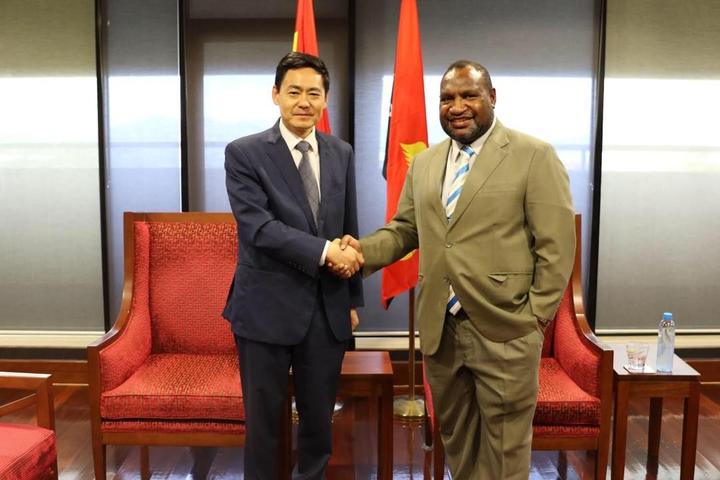
Papua New Guinea's prime minister James Marape meeting with China's Ambassador, Xue Bing, in Port Moresby. 6 August, 2019

Posted by Radio New Zealand

Papua New Guinea's prime minister has asked China to enter into a free trade agreement with his country, and for help in restructuring his government's debt.

PNG's requests came as James Marape met with China's Ambassador, Xue Bing, in Port Moresby. While the debt re-financing would first require consultations and collateral negotiations, PNG is pushing hard for a Free Trade Agreement in the hope it could be signed on an upcoming visit to Beijing by Mr Marape.
The prime minister suggested that if China opens up free trade with Pacific Island countries like his, it will help build thriving economic corridors in the region.
The new PNG leader is seeking to elevate the two countries' development cooperation, and boost Chinese investment in his country.
Mr Marape also requested China's assistance in re-financing PNG's US$7.7-billion debt.

Both the Bank of PNG and China's People's Bank are expected to consult with Papua New Guinea's Department of Treasury over the re-financing.
Mr Marape's discussions with China's ambassador also focussed on the upcoming 3rd China-Pacific Islands countries Economic Cooperation Forum to be held in Samoa in October, and the forthcoming Pacific Islands Forum meeting in Tuvalu, this month.
"I also suggested for Chinese investment in the Agriculture and Fisheries sector, and in particularly establishing down streaming processing plants for products in forestry, fisheries, mining and petroleum, and general food production and supply in PNG," Mr Marape said in a statement.
Ambassador Bing briefed Mr Marape on China's investments in PNG, the main two being the Ramu Nickel Project and the Porgera Gold Mine Project which Chinese companies are involved in.
In the case of the Ramu mine, the project is in the process of being extended
Mr Marape and Ambassador Bing also exchanged views on global food security and discussed views on entering into an Agricultural Cooperation Arrangement to supply PNG organic food and vegetables to the Chinese Market, as well as a Fisheries Agreement for Chinese investors to build fisheries processing plants in PNG.
Ambassador Bing extended an invitation for Mr Marape to visit China, with a proposed official trip expected to feature signing of Memorandums of Understanding and other technical agreements.
"These will include developments in the field of air services, tourism, mining and petroleum, electricity, construction of roads, ports, airstrips, technical and vocational education schools, and the Chinese language curriculum to be introduced in schools, and more importantly encouraging business investments from China," PM Marape said.

Go to this link for more: https://www.rnz.co.nz/international/pacific-news/396125/png-asks-china-for-free-trade-deal-and-debt-re-financing

China circles PNG amid debt blowout

Papua New Guinea Prime Minister James Marap. Picture: AFP
By Ben Packham - The Australian

Papua New Guinea has asked China to refinance its entire government debt of $11.8 billion in an unprecedented move that could give Beijing huge leverage over Australia’s nearest neighbour.

PNG Prime Minister James Marape announced the request after a meeting yesterday with Chinese ambassador Xue Bing in Port Moresby — less than a fortnight after an official visit to Australi­a at the invitation of Scott Morrison, who has sought to counter rising Chinese influence across the region.

Mr Marape, who had vowed to “take back” PNG’s resource-rich economy from foreigners, would give a formal letter of request to the ambass­ador to convey to Beijing, his ­office said in a statement.

“(The Prime Minister) requested the ambassador to inform­ Beijing on a bid to assist the government of PNG refin­ance its existing country’s K27bn debt,” the statement said. “He suggested that both the Bank of PNG and the PRC ­People’s Bank will take the lead with the Department of Treasury in ensuring that consultations are under way.”

The statement said Mr Mar­ape had also requested China enter into a free-trade agreement with Pacific Island countries, and foreshadowed a state visit by Mr Marape to Beijing.

It said the visit would be combined­ with signing agreements and talks on future co-operation on a range of projects including ports and airstrips.

The Australian understands the Australian government was already in preliminary talks with PNG to help it avoid a looming “fiscal cliff”. This included an offer of help to put together a debt re­structur­ing plan funded by the International Monetary Fund.

International banking sources, who requested anonymity for fear of antagonising China, said Beijing was likely to require collater­al — such as a major resource­s project — in case PNG defaulted on the loan.

Other countries have had to hand over key assets after falling into Chinese “debt traps”, including Sri Lanka, which was forced to sign over the Port of Hambantota on a 99-year lease when it defaulte­d on a Chinese loan.

The Lowy Institute’s Pacific program director, Jonathan Pryke, said if the deal went through, “it would be of huge bene­fit to the cash-strapped governmen­t”, consolidating short-term and ­expensive loans and helping to ­alleviate foreign exchange ­pressures.

“The risk for the lender is that, without commitments to struct­ural reform, there is no guarantee that PNG would be able to pay back the debt now owed to them,” Mr Pryke said.

“China may look for other strategic or economic guarantees that would make the $US8bn liability more palatable, but as far as I know this would be new territory for them.”

PNG’s public debt, which stands at about 32.8 per cent of GDP, is expensive to service, with 10-year bonds paying about 12 per cent interest.

PNG owes China about $870 million, or about 7 per cent of government borrowings.

PNG’s government debt for last year came in at 26.9bn kina ($11.8bn), a legacy of the O’Neill government, which borrowed heavily during the boom years of 2012-14.

This included a $1.2bn loan from investment bank UBS to buy a 10 per cent stake in the ASX-listed Oil Search, which later tanked on falling oil prices and cost PNG an estimated $420m.

Pro-China PNG MP William Duma, a former minister who was sent to the backbench by Mr Marape, welcomed the Prime Minister’s decision to seek debt consolidation assistance from China.

“Our country’s future lies with China and the rest of Asia,” Mr Duma said.

“Asian countries, starting with China, do not worry about the size of a country or how wealthy it is, but they give prominence­ to people-to-people relationships.”

Go to this link for more: https://www.theaustralian.com.au/nation/politics/china-circles-png-amid-debt-blowout/news-story/a79709b361d5dfe80fd1226b9cd6a3a8

Featured Post

Cashless in China as I study for my PhD

                                WeChat and Alipay digital payment applications By BETTY GABRIEL WAKIA - posted on PNG Attitude Blog PORT MOR...