Tuesday, July 30, 2019

Pruaitch calls for sacking of KPHL board, management

Image result for Pruaitch

Posted by The National

OPPOSITION Leader Patrick Pruaitch has called for the immediate sacking of the management and board of Kumul Petroleum Holdings Limited (KPHL) for acting against national interest and refusing to cooperate with Permanent Parliamentary Committee on Public Accounts (PAC) hearings.
“The board and management of Kumul Petroleum are behaving as though they are a law unto themselves and this should not be tolerated,” Pruaitch said.
He claimed there were at least six national interest grounds to support the sacking of the KPHL board and management, among them:
  • KPHL has made false and erroneous public statements and never reported satisfactorily to Parliament on its operational and financial status;
  • In spite of its role as a state-owned enterprise, KPHL had adversely impacted the lives of Papua New Guineans by hiding massive foreign exchange revenues in a Singapore bank account;
  • KPHL board and chief executive officer Wapu Sonk misled National Government Ministers and the public regarding its lack of support for the National Budget;
  • Although Prime Minister James Marape has decreed that KPHL will report to, and come under the jurisdiction of the Minister for State Enterprises Sasindran Muthuvel, the company has failed to cooperate with the minister;
  • No government in any country would tolerate the stance taken by KPHL as a state-owned enterprise that it was not answerable to the nation’s Parliament, or for that matter, the Public Accounts Committee; and
  • It was ethically wrong for KPHL to divert its LNG revenues to a Singapore bank account and to borrow funds from PNG banks in order to pay government dividends and for working capital.
This has a highly detrimental impact on the PNG economy.
Pruaitch said among the misleading statements attributable to KPHL was a recent July 3 statement by chairman Andrew Baing.
The Opposition leader alleged that chairman Baing that said since 2014 KPHL “has delivered to the State over K4 billion in dividends, returns of capital, taxes and other strategic, social and community in the country.
“This represent 78 per cent of KPHL’s available cashflow.
“As former Treasurer from March 2014 to May 2017, I can testify that this claim is palpable nonsense,” he said. “In 2016, KPHL paid the Government K200 million which it claimed was an advance to Government.
“As I disclosed previously, corporate taxes paid by KPHL are far below payments listed in company annual reports, a difference of K500 million just for 2014 and 2015 alone.”
Pruaitch said that, in his statement, Baing promised that KPHL would present a full and comprehensive report on its financial affairs to Parliament in the first week of July. This never happened.
On that day, Marape told Parliament Muthuvel would submit a full report to Parliament on KPHL.

Monday, July 29, 2019

PNG leader urges Australia and NZ responsibility on climate

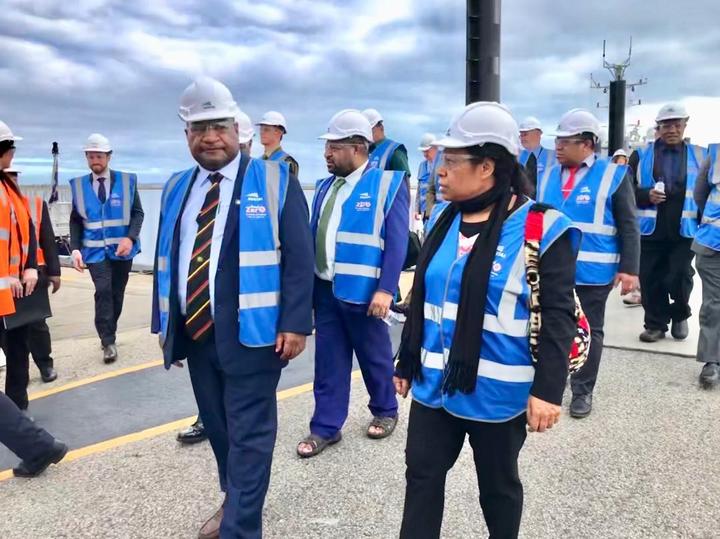
Papua New Guinea prime minister James Marape and wife Rachael (front) visit Australian ship-building company Austal in Perth, 23 July 2019

Posted by Radio New Zealand

Papua New Guinea's prime minister says Australia and New Zealand must join his country in protecting Pacific islands from climate change impacts.
James Marape has returned home after his first official visit to Australia, a six day-visit in which he met a range of officials from the prime minister to state governments.
Mr Marape told the Guardian that Australia had a moral responsibility to the upkeep of the planet, particularly given the extreme effects climate change is having on smaller Pacific nations.
He said the voices of smaller island nations must be listened to.
According to Mr Marape, Australia, New Zealand and PNG must shoulder some responsibility for the displacement of communities from the smaller regional countries caused by climate change.
He said he believed the bigger regional countries should lead the Pacific as a "bloc" of nations reconfiguring their economies to handle resource productions in a more environmentally and socially sensitive way.

New PNG Police minister to target Paladin, UBS

James Marape with Bryan Kramer in the background.

By Angus Grigg, Lisa Murray and Jonathan Shapiro - Financial Review

Papua New Guinea's Police Minister, Bryan Kramer, has pledged to investigate links between controversial security contractor Paladin and former prime minister Peter O'Neill, while calling out investment bank UBS for its "fishy" dealings in the Pacific nation.

The outspoken Mr Kramer, who was a surprise appointment to the cabinet of James Marape last month, said Mr O'Neill must be held accountable for corruption and decay during his seven years in power.

He described the former prime minister as the "centre point" of patronage networks in PNG and said one avenue of investigation was any ownership links between Mr O'Neill and security firm Black Swan, which was purchased by Paladin for an undisclosed sum in July last year.

“That is what I want to establish, to see if there is any clear lead between Black Swan and Peter O’Neill," Mr Kramer told The Australian Financial Review during a visit to Sydney.

Black Swan has been continually forced to deny any links with the family of Mr O'Neill, even as it won lucrative government contracts, including being the main security provider at the APEC regional forum last year.

The security firm was set up by Australian Brian Kelly and a relative of Mr Kramer, PNG-Australian businessman Francis Kramer. Bryan Kramer was a director of the firm until 2012. Mr Kelly was listed as the sole owner when Paladin purchased the firm. Apart from the APEC contract, Black Swan has also worked for local company Remington Technology, which is part-owned by Mr O'Neill.
Paladin's purchase of Black Swan came less than a year after it was awarded federal government contracts now worth $532 million to provide refugee services on Manus Island in PNG. Paladin was awarded these contracts without an open tender, a deal that has been the subject of heated questioning in Senate Estimates, is being investigated by the Auditor-General and is the subject on an internal audit by Home Affairs.
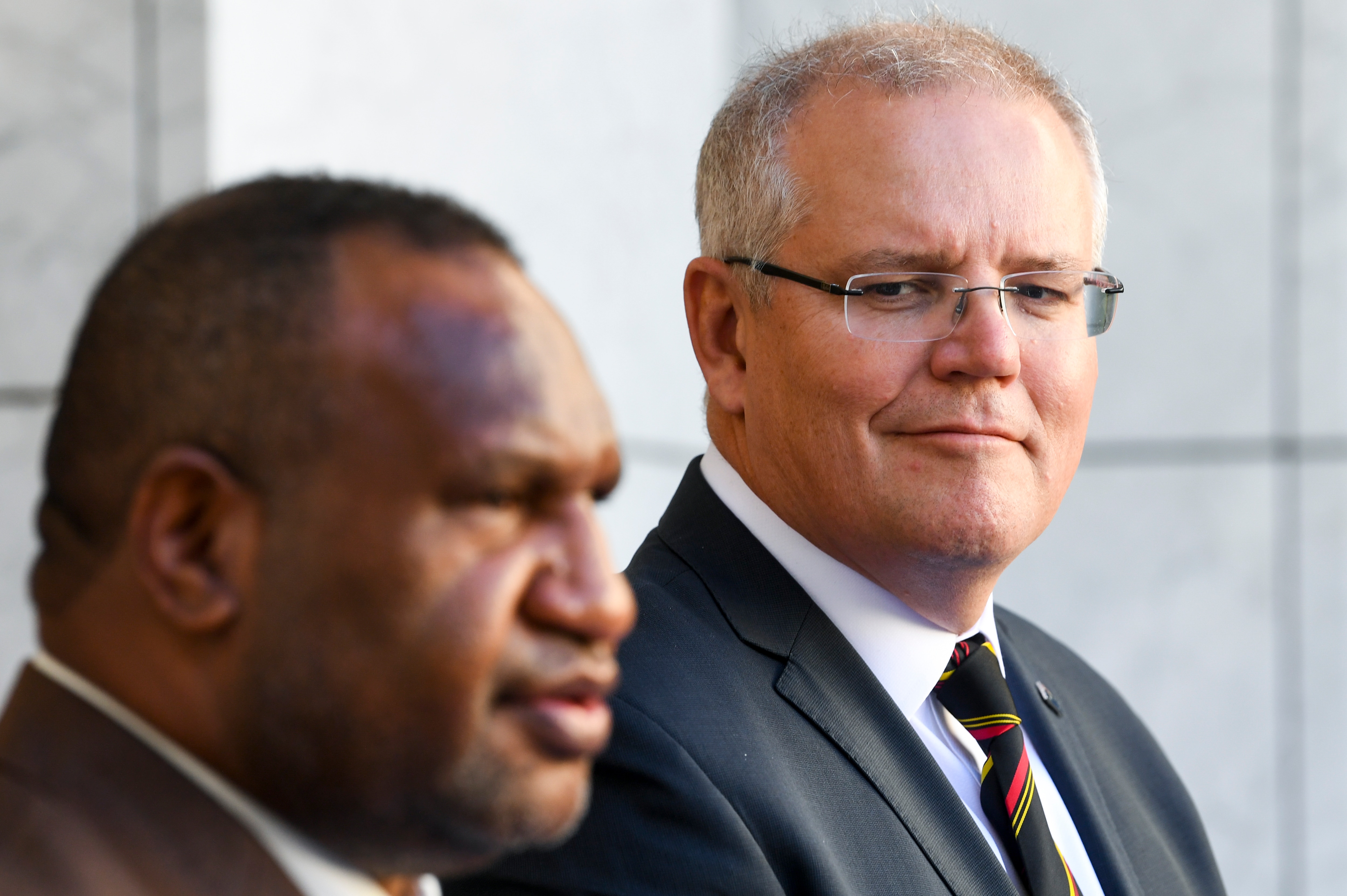
Mr Kramer was in Australia with Prime Minister James Marape, who during his week-long visit held talks with his counterpart Scott Morrison, took in a rugby league game, visited a school and gave a speech at the Lowy Institute.
"Now is the time to tackle the cancer of corruption that has taken hold, using the power of prosecution and all other means that we have at our disposal," Mr Marape told Lowy on Thursday evening in Sydney. Mr Kramer, as the newly installed Police Minister, is responsible for investigating corruption and has vowed to deliver some "real hits" within three months.
In addition he has pledged to run his own investigation into the so-called UBS loan affair, which saw PNG borrow $1.2 billion from the investment bank in March 2014 to purchase a 10 per cent stake in the ASX-listed Oil Search.
PNG is estimated to have lost around $420 million on the deal after Oil Search shares fell sharply on the back of a drop in oil prices. "The whole deal from day one was bad … you don’t borrow [money] to invest in the stock market,” Mr Kramer said.


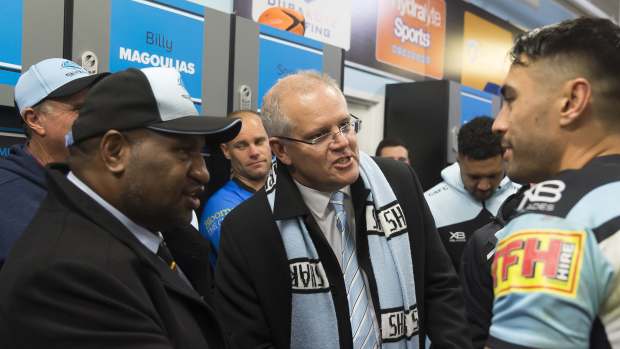
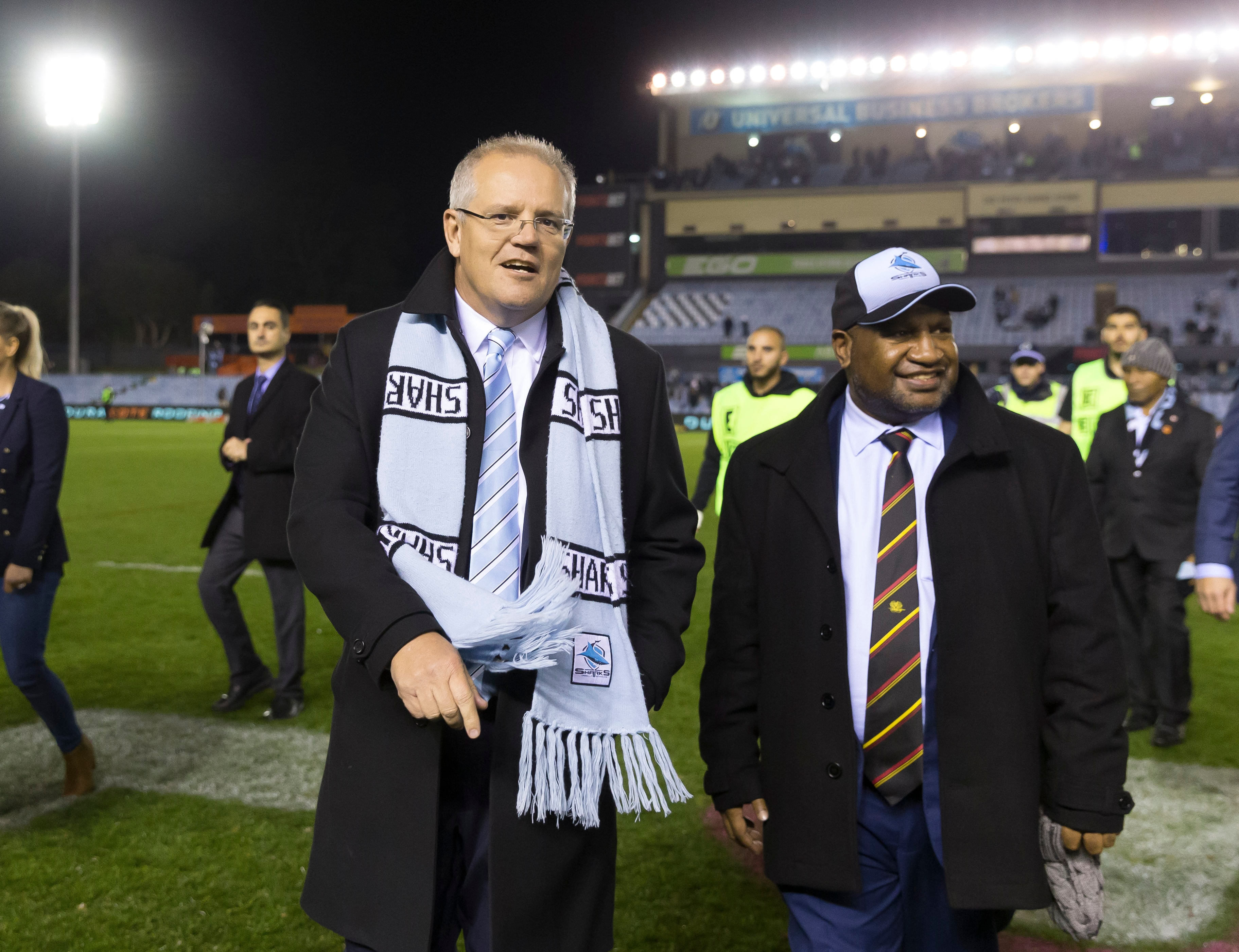
PNG PM James Marape watched a rugby league game with Scott Morrison. AAP

He said UBS, which put the deal together, should have been wary about entering into a rushed transaction, which was not approved by Parliament and was rammed through cabinet.
“The likes of UBS, these international bankers, they should have the experience to understand something that appears like a red flag transaction,” he said. “Any ordinary person in the banking industry would say this smells fishy, this entire arrangement." At issue is whether UBS either ignored or failed to ask sufficient questions around the legality of the transaction.
The Ombudsman Commission of PNG found the state solicitor was given 28 volumes of documents at midnight on the eve of a special cabinet meeting convened to approve the loan.
It found this was insufficient time to “give legal clearance”. However the state solicitor did have time to rule that parliamentary approval was required for the loan, under section 209 of the Constitution. This was never sought, which has thrown into question the legality of the deal.
In its report, the Ombudsman noted 14 of cabinet’s 33 members were not present to approve the loan, while Treasurer Don Polye resigned before the meeting in protest. “So it will come down to what they ought to have known … what the lawyers ought to have known, what UBS ought to have known,” said Mr Kramer.
The UBS loan and the transactions which followed PNG's purchase of the Oil Search stake will be examined by a Commission of Inquiry, announced by Mr Marape soon after he came to office in late May.

Mr Kramer said he would run a "parallel" investigation to the Commission of Inquiry, which will have similar powers to a royal commission but is yet to be convened or have its terms of reference settled. 
In an effort to ensure an independent Commission of Inquiry there is a push to appoint an Australian judge, with commercial expertise and PNG experience, to oversee the investigation. Mr Kramer said he was in favour of appointing an Australian judge, who could be seconded to PNG as part of Canberra's aid program.
"The perceived fairness of having someone from the outside would be a step in the right direction, the better option,” he said. "It would be the best way forward, assuming a foreign judge would take that position.”


Warlord in Hela surrenders after Marape’s warning


By PISAI GUMAR- The National

A WARLORD in Hela has given himself up to the security forces in response to a warning by Tari-Pori MP James Marape that he was coming after those involved in recent killings.
Warlord Libe Koi from Pujaro village in Tagali, where more than 20 women and children were recently killed, apologised to the relatives of all those killed during the six years of fighting.
He also said sorry to the government and members of the security forces.
Koi urged the two other warlords still in hiding to come out before he exposed them.
“I appeal to two other warlords in the recent massacre to surrender themselves and weapons because I will disclose their hideouts (if they fail to surrender),” he said.
“If I can surrender myself, why don’t you two also come out for us to find an amicable solution to restore peace and harmony in Hela?”
Libe said he fought hard against a landlord identified as Okiru in the last six years to protect his family from being wiped out.
“A cease fire and peace mediation was held at Tari police station on July 24, 2017, between me and Okiru to compensate for the killings.
However, no compensation was paid until 2018. Instead Okiru went ahead to kill another three people. “It incited me to retaliate in 2018,” he said.
Soon after recent massacre in Tagali, the Government declared Tagali, Haiyapaga, South Koroba, Tebi and Pori as “fighting zone”.
Libe was assisted by Pujaro chief Karoma Iripu in surrendering to Hela police commander Chief Inspector Teddy Agwi, military operations commander Lt-Col Major Anthony Mota and administrator William Bando last week.

Go to this link for more: https://www.thenational.com.pg/warlord-in-hela-surrenders-after-marapes-warning/

Sunday, July 28, 2019

PNG PM vows to improve his citizens' access to Australian visas


BY BRETT MASON & ROSEMARY BOLGER - SBS News

Papua New Guineans will be able to travel to Australia more easily under changes being pursued by Prime Minister James Marape. 
Speaking in Sydney, Mr Marape told SBS News he was determined to resolve ongoing issues making it difficult for PNG residents to access Australia. 
"It's a work in progress, but it's something that I want to achieve in my time in office - better access by Papua New Guinea into Australia in a modernised system where immigration is easily managed." 
PNG may be Australia's closest neighbour, but concerns about the country's border security management have created headaches for residents trying to get visas. 
Mr Marape said he understands Australia's "insecurities" and has vowed to strengthen their border security management system. 
Prime Minister Scott Morrison with Papua New Guinea Prime Minister James Marape on Thursday night.
AAP
In a wide-ranging interview with SBS News on Friday, the PNG prime minister declared his week-long trip to Australia a success. 
"Both prime ministers have agreed it's no longer an aid-donor recipient relationship, it's now about economic relationships where Australia sees PNG as an important trade and economic partner and for PNG, we can see Australia as a great market place for our local produce." 
Having built his country into "the richest black Christian nation on the face of planet earth", Mr Marape has declared PNG will not need Australian aid for long. 
"Ten years from now I would like PNG to be elevated to a status of economically sound and strong. Where we're able to help Australia assist in the Pacific region.
"We can only do that by when we are economically strong and resilient and independent ourselves."
After spending Thursday night at a rugby league game with Mr Morrison, Mr Marape praised his Australian counterpart's "human touch". 
"We entered politics at the same time in 2007... by the grace of God, he has become PM in the Australia side and I have become PM in the PNG side."
Prime Minister Scott Morrison and his PNG counterpart James Marape discussed the future of Manus Island in Canberra on Monday.
AAP
But there are key issues where the two disagree. Mr Marape has demanded an end to offshore processing on Manus Island where about 350 asylum seekers and refugees have spent up to six years.
Mr Morrison would not set a date for the closure of Australian-run detention facilities, but has agreed to work out a schedule.  
Action on climate change - the biggest threat facing Pacific nations - is another source of tension. 
While Mr Marape said it was not his position to tell Australia what to do, he suggested Australia consider its role in the region. 
"I think our combined voice of global states is important. Australia needs to unite behind the entire Pacific group of nations."
Go to this link for more: https://www.sbs.com.au/news/png-pm-vows-to-improve-his-citizens-access-to-australian-visas?fbclid=IwAR0_gTuiHyjeOOCgbRrppGM1imMddDmAVdsobrzdh1pi6mPgPz9Vlw-_pqk

Papua New Guinea’s First Neurosurgeon – Dr Esther Roibete Apuahe


Posted by PNG ICT Meri

Came across this story on Facebook shared by Senisim Pasin Page.
Papua New Guinea’s first neurosurgeon, Dr Esther Roibete Apuahe.
So many inspiring stories of our people that need to be shared through every platform and media.
Dr Apuahe’s encouragement to young girls is to remember that success comes with perseverance and determination.
“Nothing will be served to you on the silver plate, go out and make it happen for you. You are the only one who will decide your destiny. Reach for the sky, no one is a failure. And in all this, remember, nothing is impossible with God”.
The Townsville Hospital is training the next generation of Papua New Guinean neurosurgeons under the tutelage of neurosurgery consultant Dr Eric Guazzo and the neurosurgery department.
Dr Esther Apuahe is the first female Papua New Guinean national to train as a general surgeon and will be the third doctor to hone her skills in neurosurgery at The Townsville Hospital.
Having practised medicine in Papua New Guinea for 15 years and inspiring other women to follow in her footsteps along the way, Esther said she was thrilled to be taking the opportunity to learn at The Townsville Hospital.
Esther said the Royal Australasian College of Surgeons had made her training at The Townsville Hospital possible.
“I was awarded the Pacific Island Rowan Nicks Scholarship which enabled my year-long placement at The Townsville Hospital and I’m really grateful for that.
“I was working in one of the provincial hospitals in Papua New Guinea when two local neurosurgeons couldn’t continue to provide the service creating the opportunity for me to train in neurosurgery,” she said.
“It’s a wonderful moment to be continuing this journey at The Townsville Hospital and I’m extremely grateful to be doing this under the leadership of Dr Eric Guazzo and his team.
“I’m enjoying working in a well established neurosurgery unit and I’m hoping to learn the use of more advanced equipment.
“I’m also excited to further my knowledge on neuroanatomy, neurophysiology and neuroradiology and upskill my own
surgical techniques.”
Esther said she hoped to use the skills learned at The Townsville Hospital to benefit her community when she returned to Papua New Guinea.
“It is so generous of Eric and his neurosurgery colleagues to impart their vast knowledge and experience to help me to do this,” she said.
“The Townsville Hospital has always supported training Papua New Guinean neurosurgical trainees and Dr Eric Guazzo
has been one of the biggest contributors to neurosurgical training in PNG.”
Eric said he and his team were honoured to invest in the future of neurosurgery in Papua New Guinea.
“Every country should have access to well-trained physicians in a variety of specialities,” Eric said.
“Medicine is a continuous journey of learning and knowledge and we see sharing expertise with doctors such as Esther, who are passionate about providing critical health care specialities to their communities, as a part of our responsibility as doctors,” Eric said.
“Dr Apuahe is already a talented physician and her eagerness to further develop herself as a neurosurgery specialist is inspiring.
“As we found with Esther’s predecessors, this is a two-way learning process; we grow in our own knowledge from Esther, particularly learning from the way she manages the immense challenges of providing health care to her community.
“We are privileged to have the opportunity to play a part in developing the next generation of neurosurgery specialists in Papua New Guinea and it is incredibly rewarding.”

Did police mobile squad’s decline contribute to Hela killings?

Mobile-squad
By DAVE EKINS - PNG Attitude
RICHMOND, TAS - Prior to the commencement of the Papua New Guinea liquefied natural gas (PNG LNG) project, the Police Mobile Squad was an extremely feared entity in the Southern Highlands and later Hela Province.
Their Royal Papua New Guinea Constabulary’s mobile squad had a modus operandi that at times was brutal – including rape, destruction of crops and livestock and burning of houses.
However, they did stop the fighting and brought most of the criminals to heel.
The very threat of their deployment made clans think twice about fighting and payback. Not only would compensation have to be paid between warring clans, but the mobile squad’s collateral damage usually had to be compensated for as well by the fight ‘owners’.
Early in the construction phase of PNG LNG there was a fight going on adjacent to one of the camps and some of the combatants jumped the perimeter fence when they saw a couple of people from another clan working in the camp.

The latter fled and the former climbed back over the fence, reassuring gob-smacked on-lookers that they were quite safe as they were only interested in their enemies.
But there was a consequence.
ExxonMobil head office immediately threatened to halt construction on the project if the PNG government did not guarantee security of the workforce.
The upshot was that the mobile squad was deployed throughout the project area to act as Exxon Mobil’s armed security force.
The police were funded and rationed by Exxon but commanded by their police hierarchy. They were also asked to moderate their usual slash and burn style of law enforcement.
The PNG LNG project thus became security based, unlike its junior partner, Oil Search, which was, and still is, community affairs based.
But, apart from a few token applications of fan-belt therapy applied to the odd recalcitrant tribesman, the mobile squad gradually became neutered.
Its normal modus operandi was curtailed by less onerous security duties and a good life including three massive meals a days, pay allowances and plenty of games of cards and darts.
The regular police looked with envy at the lifestyle of the mobile squad, which may have contributed to their own decline into corruption and ineffectiveness at all levels.
Over the years, the local population was emboldened by a growing lack of fear of the mobile squad and tribal fights, camp invasions and property destruction became the norm in the project area.
The clans learned that no one in the project camps would venture from their secure havens, go through the gate and confront them.
Meanwhile, Oil Search continues to effectively engage with its communities. Community affairs staff are the first out of the gate if trouble is brewing and they are yet to have a major camp invasion despite over 25 years of operations in the most volatile part of PNG.
Go this link for more: https://asopa.typepad.com/asopa_people/2019/07/did-police-mobile-squads-decline-contribute-to-hela-killings.html

Featured Post

Cashless in China as I study for my PhD

                                WeChat and Alipay digital payment applications By BETTY GABRIEL WAKIA - posted on PNG Attitude Blog PORT MOR...